The 5 pillars of islam in arabic are not just names that every Muslim recites, but they are the pillars of Islam in the Arabic language, the language of the Quran and the Sunnah. Understanding the Arabic words, pronunciation, and linguistic roots gives one a better idea of the meaning of their words than simple translation. This guide covers the learning of each pillar in Arabic as well as its translation and how these five pillars affect a Muslim’s daily life and worship.
What Are the 5 Pillars of Islam in Arabic?
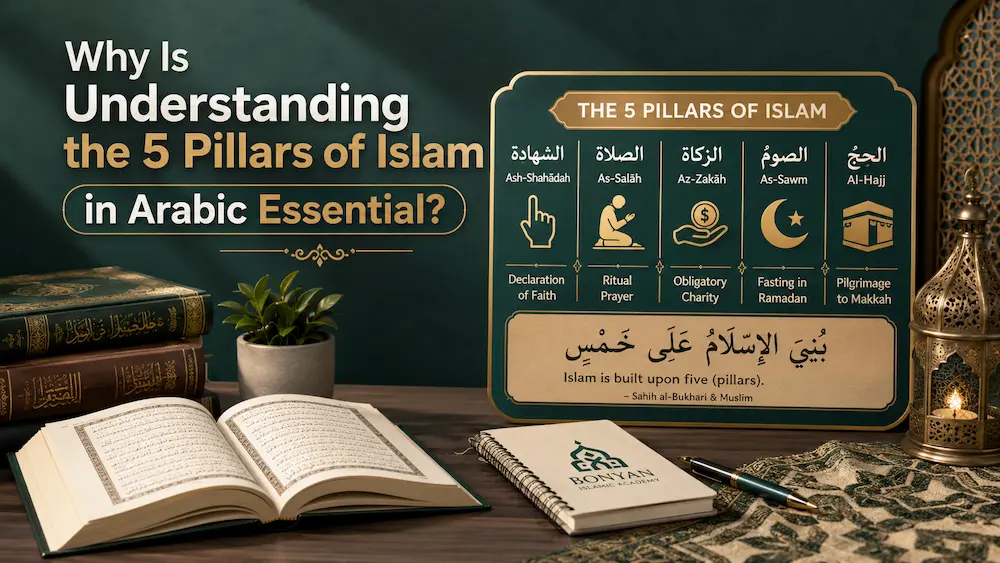
The five pillars of Islam in Arabic are Shahada (belief), Salah (prayer), Zakat (charity), Sawm (fast) and Hajj (pilgrimage). Together they make up the five obligatory acts, which form the foundation of the practice of every Muslim, Arkan al-Islam (أركان الإسلام).
Each pillar has been placed in a certain order so that worship needs to be preceded by belief and that charity, fasting and pilgrimage are dependent upon the sincerity of the first pillar.
The 5 pillars of Islam in Arabic and English at a glance:
| Arabic | Transliteration | English meaning |
|---|---|---|
| الشهادة | Ash-Shahādah | Declaration of Faith |
| الصلاة | As-Salāh | Ritual Prayer |
| الزكاة | Az-Zakāh | Obligatory Charity |
| الصوم | As-Sawm | Fasting in Ramadan |
| الحج | Al-Hajj | Pilagrimaged to Makkah |
This is the normal recitation of the 5 pillars of Islam, because each pillar is dependent on the previous one.
Join to our islamic studies Course .
What Is the True Spiritual Meaning of the Pillars of Islam in Arabic?
Every Arabic word has a spiritual meaning that is not conveyed by its English counterpart. Shahada is not only a “declaration”; it is the declaration of the tongue, heart, and limbs all at once, which English cannot fit into one word.
Salah does not mean ‘prayer’; it means the regular and active relationship between the servant and his Creator, five times a day, not as a ritual he was forced to carry out. Hence, the teaching of the pillars in Islamic education has always been taught in Arabic, then 5 Pillars of Islam in English.
Why Are the Pillars of Islam in Arabic Essential for Every Muslim?
They are necessary because the pillars were communicated, explained and formalised in Arabic, and no translation can convey their bindingness. In the earliest and most authentic stating of these obligations, a hadith transmitted by Ibn Umar in Sahih al-Bukhari and Sahih Muslim states that Islam has five pillars.
By learning the 5 pillars of Islam in Arabic Hadith text, a student is still bound to the original text, which has been used by scholars for more than 1400 years, and will not fall into a second-hand paraphrase that can change meaning over time.
Explore the Best Islamic Online Courses .
What Are the Arabic Roots Behind the Pillars of Islam Meanings?
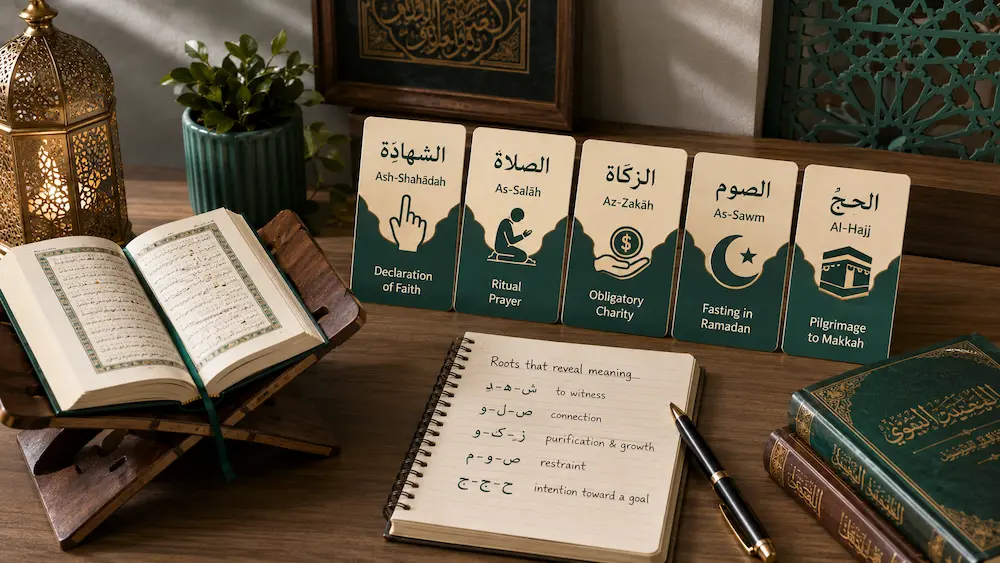
Every pillar’s name comes from a three-letter Arabic root that reveals its deeper function, not just its label:
- Shahada root ش-ه-د (shahida), “to witness,” used for legal testimony as well as faith.
- Salah root ص-ل-و (salaw), meaning connection, not simply “bowing.”
- Zakah root ز-ك-و (zaka), meaning both purification and growth.
- Sawm root ص-و-م (sawm), meaning restraint or abstention.
- Hajj root ح-ج-ج (hajja), meaning intention toward a goal.
Recognizing these roots turns five separate words into one connected vocabulary system, which is exactly how Al-Azhar-trained teachers introduce Arabic Islamic terminology to new students.
How Do You Pronounce and Write the 5 Pillars of Islam in Arabic?
Correct pronunciation depends on Arabic letters that do not have an equivalent in English, such as the letter ح (Haa) in the word Hajj and the letter ص (Saad) in the words Salah and Sawm (which are pronounced from a deeper level in the throat than the English-sounding letters suggest).
It is important to write the pillars correctly as well: Salah is spelled الصلاة and not الصلاح (which means “righteousness” in Arabic), a common mistake of self-taught learners who are studying it by transliteration rather than the Arabic script.
Explore the best islamic studies programs in usa .
Pillars of Islam in Arabic vs English: What’s the Difference?
Precision is the main difference. The Arabic words for the 5 pillars of Islam in order are vastly different in meaning from the words in English. When you compare the 5 Pillars in Arabic to the English translation, you will see that words such as ‘charity’ or ‘fasting’ refer to an action, whereas ‘charity,’ ‘fasting,’ etc., in Arabic refer to a legal category with clearly stated conditions, minimums, and exceptions.
In English, “charity” is defined as anything done freely, but for Zakah there is a specific percentage of 2.5%, the specific recipients, and a mandatory time that is determined by lunar year, none of which can be inferred from the English word alone.
What Do the Pillars of Islam in Arabic Reveal About True Faith?
They show that faith in Islam is never abstract; it is organized, quantifiable, and embodied in the body as well as the mind and heart. The Shahada is verbal and mental, the Salah is physical and mental, Sawm is physical, and Zakah and Hajj are financial and physical.
This layered structure demonstrates that the concept of belief and matters related to it were never separated from action in 5 pillars of Islam in Quran and Sunnah, but each pillar demands an internal conviction to be revealed as an external verifiable action.
How Do the Pillars of Islam in Arabic Guide Daily Life and Worship?
The pillars established a pattern or rhythm for a practicing Muslim’s day and year. Salah organizes the day into five set times for prayer, Sawm organizes one month of the year around the concept of self-restraint, and Zakah brings structure to the accountability of finances on a yearly basis.
One duty is repeated throughout the life of every Muslim, and the other is repeated just once per person’s lifetime.
Explore the best Accredited Islamic Studies online .
Common Mistakes When Learning the Pillars of Islam in Arabic :-
The self-taught learners make a few common mistakes:
- Learning transliteration is memorized, without ever reading the Arabic script, leading to permanent mispronunciation.
- Mixing similar-lookinging letters such as ص and س and altering the meaning of a word.
- Ascribing to the equality between the 6 pillars of Iman (belief in Allah, His angels, His books, His messengers, the Last Day, and Divine decree) and the 5 pillars of Islam, the first of which governs the heart and the latter governs the actions.
- Not memorizing each pillar by its Arabic roots, but rather by itself, making the vocabulary more difficult to recall.
What Are the Best Practical Memory Tips for Memorizing the 5 Pillars of Islam in Arabic?
The most effective method pairs each Arabic term with its root meaning rather than rote repetition alone, since a word tied to a concept sticks longer than a word memorized in isolation.
- Say each term aloud from the Arabic script, never from transliteration only.
- Group the pillars by category: belief (Shahada), worship (Salah, Sawm), and wealth (Zakah, Hajj).
- Review the Ibn Umar hadith weekly hearing all five in one sentence reinforces the sequence naturally.
How Does bonyan islamic Academy Simplify the 5 Pillars of Islam in Arabic for Global Learners?
Bonyan Islamic Academy teaches the 5 pillars of Islam in Arabic through live, one-on-one classes with Al-Azhar-certified teachers, rather than pre-recorded lessons that can’t correct a student’s pronunciation in real time. The academy has delivered over 80,000 teaching hours to more than 1,000 students across 20+ countries, maintaining a 4.9/5 rating from 200+ verified reviews.
Students begin with a free trial class where a teacher assesses their current Arabic reading level before building a personalized study plan, so foundational terms like Shahada and Salah are taught with correct script and pronunciation from lesson one.
Explore the best islamic online academy .
Conclusion
Understanding the 5 pillars of Islam in Arabic isn’t just a memorization exercise; it’s the foundation every other area of Islamic knowledge builds on. For a guided start with a certified Al-Azhar teacher who can correct your pronunciation and script from the first lesson, book your free trial class with Bonyan Islamic Academy on WhatsApp.
F&Qs
Are the 5 pillars of Islam in Arabic the same across all Islamic schools of thought?
Yes. All major schools of thought agree on the same five pillars and their Arabic names; differences between schools appear in the details of how each pillar is performed, not in the pillars themselves.
Do children need to learn the Arabic terms before the English meanings?
Either order works, but pairing both from the start, the 5 pillars of Islam in Arabic and English, helps children connect the sound of the word to its meaning faster than learning them separately.
Is the Shahada considered one pillar or two, since it has two parts?
It’s counted as a single pillar. Scholars explain the two testimonies, belief in Allah’s oneness and in Muhammad’s ﷺ prophethood, as inseparable halves of one act of witnessing.
Can an adult revert learn these pillars without prior Arabic knowledge?
Yes, and it’s extremely common. Reputable programs start reverts with the Arabic alphabet and pillar vocabulary side by side, with no assumed background required.