Basic Arabic speaking lessons help transform a collection of Arabic words into genuine conversation skills, but most English speakers give up within weeks, as no one provides them with a clear direction. This guide will explain why you may find it difficult to How to learn Arabic words at first, why structured lessons are better than self-study apps, why you need to choose a dialect, and why you need to practice every day to become fluent. If you’re just beginning or you’ve been trying but nothing’s working, you’ll end with a clear plan on what to do next.
Why Master Arabic Spoken Fundamentals to Unlock Careers?
The mastery of Arabic basic conversational skills unlocks opportunities for translation, tourism, trade, diplomacy, and religious studies in Arabic in the 22 countries where Arabic is an official language. In aviation, humanitarian assistance, and business in the Gulf region, employers almost exclusively look for the ability to speak Arabic to English and not the grammar score on a written test.
In the case of Muslim learners, spoken fundamentals are directly related to religious life. Basic Arabic speaking lessons are the foundation of understanding a khutbah, following along in prayer and even reading the Quran with true comprehension. Hence, the overlap of speaking fluently makes a difference twice, professionally and spiritually, in the same amount of study time.
Explore how to Learn Arabic in English Step by Step .
How Can Basic Arabic Speaking Lessons Help You Learn Fast?
The learning of basic Arabic speaking skills accelerates by engaging in real conversation from the first lesson with correct pronunciation, rather than months of grammar first. Structured lessons shorten the trial-and-error period that self-taught learners typically experience over many years. Here’s how:
- Immediate correction: A teacher catches a mispronunciation of a letter when it occurs, rather than when it has become the habit.
- Guided sequencing: You learn words in the order that you will need them, rather than alphabetically or randomly (you will learn greetings, questions, daily needs, etc.).
- Repetition with variation: Spoken language sticks when you repeat the same core vocabulary in new sentences each week, with variation.
- Built in accountability: is better than an app notification that you swipe.
What Makes Basic Arabic Speaking Lessons More Effective Than Solo Study?
The difference is: live feedback. Basic arabic speaking lessons for beginners are more effective than self-study because the teacher adapts to what you understand, not what he/she thinks you should understand. That one difference is what most self-study paths lack altogether; a person watching you struggle and adjusting in real time.
Join our Arabic Language Course .
Why Do English Speakers Struggle with Arabic Phonics?
The difficulties English speakers have with Arabic phonics are due to the presence of sounds in Arabic that are not present in English, namely emphatic consonants and guttural letters. The mouth must learn all new positions, not only new symbols.
An example of this is the difference between the words ق (qalb, heart) and ك (kalb, dog), which is a single point of articulation shift in the back of the throat but changes the meaning of the word. The difference will not be picked up by the ear of the English speaker until after the first hearing, as their ear had not been trained to hear it.
That’s also the reason why basic Arabic speaking lessons that teach you to listen first and then speak are better than lessons that teach you to look at lists of words that you cannot say a sound correctly until you can hear it correctly. With sufficient practice (typically the first few weeks), the ear will catch up, and then the mouth will catch up.
How Can You Transition from Reading to Speaking Arabic?
You move from reading to speaking Arabic from the beginning, reading sentences out loud, rather than reading and speaking them simultaneously. Most people who learn to read on their own can read the words silently, but when they come to say the sentence, their vocal muscles freeze because they did not develop the muscle memory. To fix that:
- Even when you study alone, read all the new words out loud, as you read them with your eyes, you’ll read them with your mouth.
- Cover and repeat the text immediately after reading it once.
- Read sentences and ask questions and provide answers aloud: I am a student. “Are you a student?
- Use short dialogues to practice, not single words; reading turns into speech right away.
This is exactly how Bonyan Academy’s course structure; students progress from letters (Noor Al-Bayan) into full sentences without a break in learning between the two.
Read more about the basic arabic lessons for beginners .
How Can You Practice Speaking Fluently Without a Live Partner?
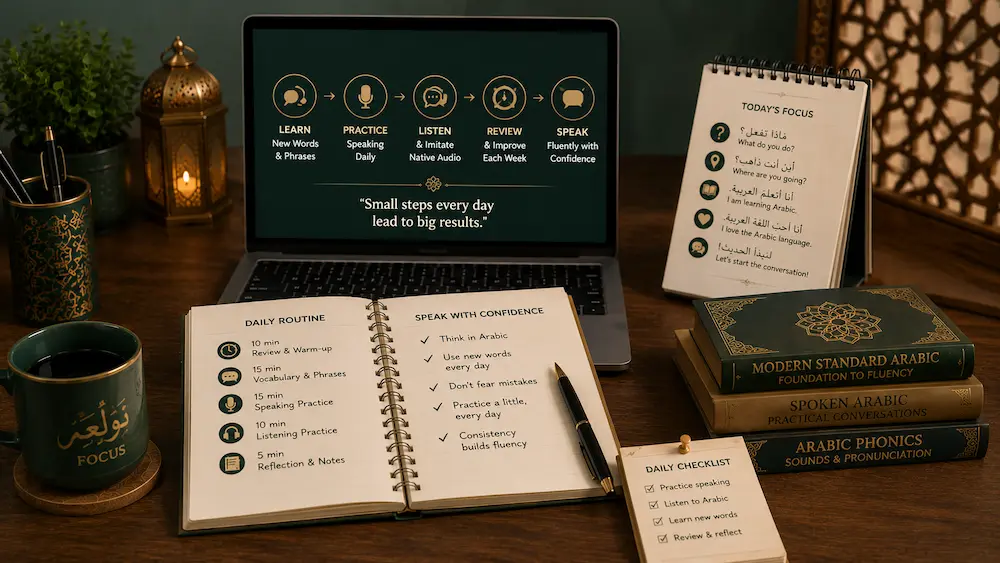
To practice fluency in speaking, talk to yourself out loud in Arabic, describing your surroundings, your day, or your plans. This is not a less intensive alternative to conversation practice; it is the same muscle, but self-directed. Practical ways to do it:
- Shadow native audio: play a short sample, pause, and repeat the exact rhythm and stress of the words this time.
- Record yourself every day, and play back a native clip a week later and listen to the actual improvement.
- Tell in silence and in Arabic: “Now I’m making coffee” and “Now I’m leaving the house.”
- Record a study group in Arabic, even if no one responds right away: the production is more important than the response.
This is all supplementary to live correction but is a good fill-in between the weekly basic Arabic speaking lessons to prevent your speaking muscles going limp for six days at a time.
Basic Arabic Speaking Lessons Versus Self-Study Apps Comparison
The main difference lies between the ability of live correction and self-graded practice apps to teach vocabulary. There are substantial differences between the two paths in terms of outcomes, cost, and structure.
| Feature | Basic Arabic Speaking Lessons (Live Teacher) | Self-Study Apps |
|---|---|---|
| Pronunciation correction | Immediate, live, every session | None self-graded only |
| Level structure | Smooth flow of beginner → intermediate → conversation | Easy to skip basics, the user sets their own order. |
| Speaking practice | Real conversation all classes | The majority of the content is mostly typing and multiple choice. |
| Typical cost | Structured weekly sessions, approximately $24-$80/month | The average rates of private online tutors on the open market are within the range of $10 to $40 per hour, while app subscriptions are priced between $10 and $15 per month, and without live speaking. |
| Progress tracking | Each month a named teacher will provide a report. | Lacks cells are never tracked or accounted for.There is no formal tracking or accountability. |
| Dialect guidance | Teacher uses Modern Standard and spoken dialects as needed for your objective | Set up some content that doesn’t change often according to your objective. |
Though useful for vocabulary drills between lessons, an app cannot teach the learner the corrected mouth, it can only give him a list of memorized words. The next question a live teacher can help you answer correctly is which Arabic to learn first.
Explore the best islamic online academy .
How Do You Navigate Common Arabic Dialect Choices Safely?
You can safely play with the different Arabic dialects by learning Modern Standard Arabic (MSA) first and then adding a spoken dialect on top. One of the most frequent pitfalls of beginners is selecting a dialect at an early stage, before they have established a solid base. A safer lane is this:
- Begin with Modern Standard Arabic: it is understood in all Arab countries and is the same Arabic that is used in the Quran, formal media, and news.
- Pick a dialect according to your objective: Egyptian for mass media, Levantine for the Middle East or Gulf/Khaleeji if you are targeting the Middle East Gulf communities.
- Avoid using mixed words; if it takes a while to master Egyptian words, use them in their entirety, rather than trying to use the Gulf words in the beginning and then switching to Egyptian.
- Get your teacher to point out dialect words clearly: always know which register you are using and why.
The key to avoiding one big mistake is getting the dialect correct, but there are numerous other little mistakes that quietly sap the momentum of the beginning player.
What Are the Most Common Spoken Arabic Mistakes to Avoid?
The most frequent errors in speaking Arabic include rushing through pronunciation, memorizing words without sentences, and not speaking until “ready.” All three stall progress for months quietly. Keep an eye out for these in particular:
- Not practicing the difficult letters of the alphabet (ع, غ, ق, ح) but simply avoiding them.
- Learning word lists without a sentence context, so you can’t use the words you “know.
- Don’t wait until you have it 100% right; it’s only after you have it 100% wrong.
- Omission of short vowels (harakat): These vowels are silent and change the meaning of the word and are so easy to miss when reading unvoweled text.
- Translation from English rather than by learning Arabic sentence patterns.
Just two of these speaking earlier and drilling the hard letters make a difference in the rest of this list. But none of these fixes will last without regular repetition of them.
Explore the best way to learn quranic arabic .
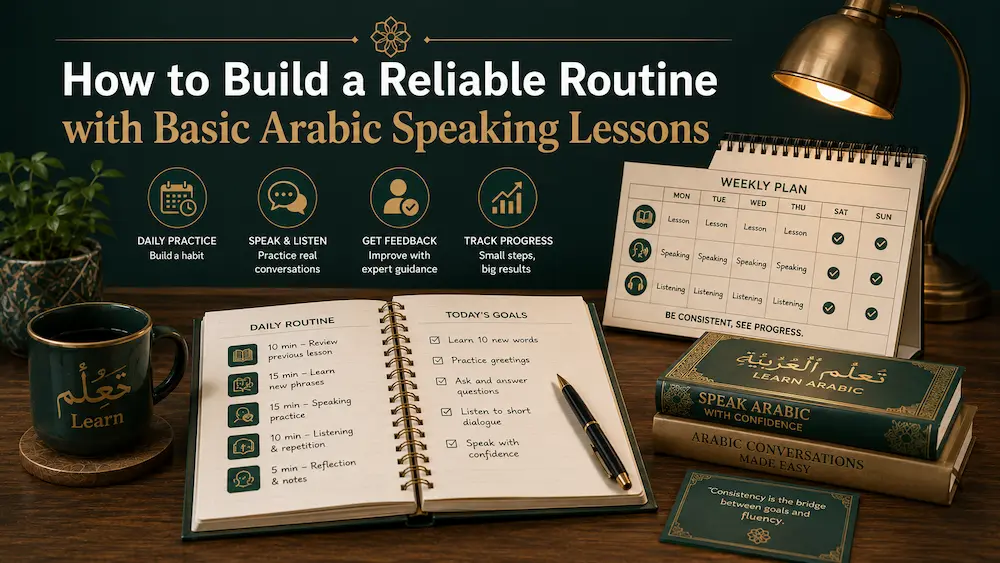
How Do You Build a Reliable Arabic Speaking Routine?
By making it a habit to practice Arabic at a set time daily, no matter how brief, you establish a solid Arabic-speaking habit. For spoken language, consistency trumps intensity. A normal routine is like this:
- Choose a time that cannot be changed, such as immediately after the Fajr time, or during a travel period, or before sleeping.
- Take live classes at a regular time every week; don’t let speaking practice be a matter of willpower.
- Increase the amount of self-talk or shadowing between lessons (10 minutes per day).
- Before adding words, review, don’t just add last week’s words too, so they don’t get forgotten.
- Seeing it is a great way to keep it from slipping away (a simple streak count or checklist works great).
A routine like this is precisely what a well-structured course schedule is meant to safeguard, and that’s where a dedicated teacher and regular weekly time make the difference between a habit and a hobby. This is the very thing that Bonyan Academy’s Arabic language course with certificate structure is designed to fill.
Why is Bonyan Islamic Academy Your Perfect Partner for Learning Arabic as an English Speaker ?
Bonyan Academy was designed for Muslim families who speak English and desire to learn it fluently, not just grammatically. All Arabic teachers on the platform are Al-Azhar certified and trained in the scientifically proven Noor Al-Bayan method to teach letter pronunciation and phonics, meaning that the beginners do not learn to form letters incorrectly and will be able to articulate properly from the first day of lessons.
The course is structured in a clear three-level progression: beginner (letters and phonics), intermediate (sentence-building and grammar), and conversation (live dialogue and listening). Every student is always sure of his or her level and what will follow.
It’s not just that progress is made; it’s that over 1,000 students from 20+ countries have accumulated over 80,000 teaching hours on the platform, and they’ve received over 200+ verified Google and Trustpilot reviews with an average rating of 4.9/5.
Each student is also provided with a monthly progress report that reflects their progress in listening, speaking, reading, and writing and is available on the same smart dashboard that is seen by all of Bonyan’s 100+ certified teachers.
Plans begin at $24/month for one weekly session and go up to $80/month for four sessions per week, with a 20% sibling discount and no long-term contract. You’ll get a free trial class so you can get to know your teacher and try out the method before you sign up.
Conclusion
Basic Arabic speaking lessons are effective as long as three conditions are met simultaneously: the correct pronunciation from the beginning, real-life speaking practice weekly, and a consistent routine that allows one to retain the material. Those who learn to skip any one of the three, and progress slows down, and that’s what most of the self-taught attempts get wrong. If you prefer to have a teacher correct you while you’re in the class, and create the plan based on your actual level.
book a free trial class with Bonyan Academy it takes under two minutes, and there’s no credit card required.
F&Qs
How many basic Arabic speaking lessons do I need before I can hold a simple conversation?
After about 2–3 months of daily, regular activity, most learners will be able to hold short and simple conversations. The time it takes will depend more on consistency than on natural talent.
Can adults learn spoken Arabic as quickly as children?
Yes, adults typically learn more quickly at the beginning as they can learn to use pronunciation rules and grammar patterns more consciously than children, who learn to do the same more slowly and naturally.
Do I need to memorize grammar rules before I start speaking?
No. It is easier to learn grammar when you have a few correct and simple sentences in your head than it is to memorize rules that you cannot use for sentences.
Is a private teacher better than a language exchange partner for speaking practice?
Yes, for the beginner level. A language partner can help practice with you, but typically cannot correct subtle pronunciation mistakes; a trained teacher catches and corrects those mistakes before they become ingrained habits.