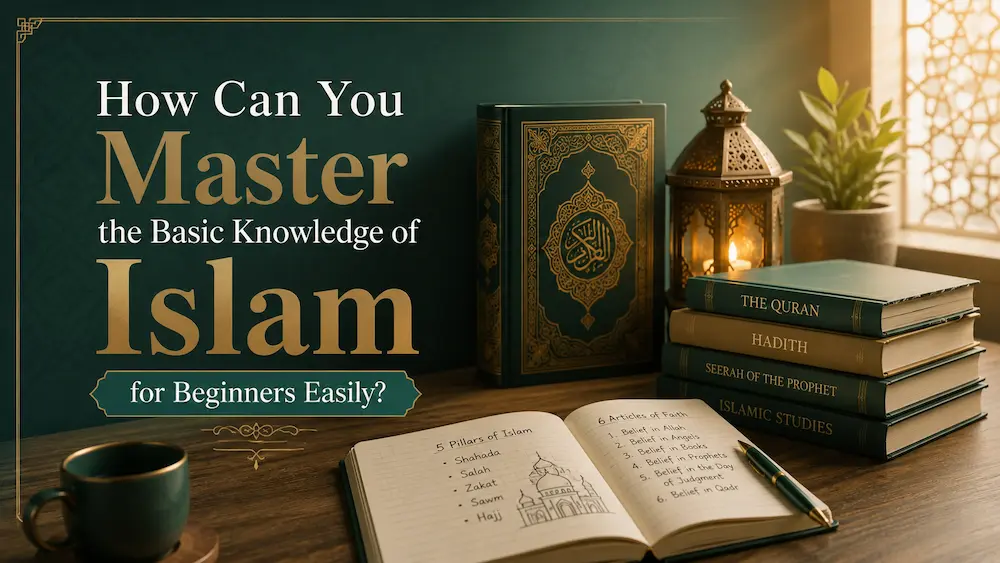
Acquiring the basic knowledge of Islam for beginners is the first step to understanding the beliefs, values, and practices of Muslims all over the world. If you are new to Islam, you are curious about it, or you just want to deepen your understanding, then you can find it easier to understand and make more sense of the basics. This booklet presents the fundamentals of Islam in a simple and easy-to-understand manner so that you can gain confidence as you learn more.
Why Is Seeking Basic Knowledge of Islam for Beginners the Essential First Step?
It provides a real framework rather than information that is random and contradictory. The initial step is basic knowledge of Islam for beginners. The world’s Muslim population growth led Pew Research Center’s analysis of more than 2,700 demographic sources to estimate that Muslims now make up about a quarter of the world’s population, having grown by 347 million people between 2010 and 2020.
If you don’t have a plan for getting started, it is easy to fall into one of two pitfalls: watching a bunch of little social media videos and believing it or trying to take in everything and getting overwhelmed in weeks.
When learning about Islam as a Muslim for beginners, it is best to steer clear of extremes and to have a predetermined sequence in which to learn the subject. This is true for anyone who is learning Islam, even if they already know something about it from a culture but have never learned it formally, as well as for someone who has learned nothing about Islam.
Explore the best islamic studies programs in usa .
What Is the Absolute Core Meaning of Islam and Being a Muslim?
Islam is the surrender to the will of Allah, and a Muslim is one who surrenders to the will of Allah. It is derived from the Arabic root s-l-m, which also gives rise to the word “salaam” (peace).
This isn’t passive submission. It is a living decision, a daily decision, which is to follow God’s will in one’s beliefs, one’s worship, and one’s behavior, instead of one’s own. This is the same message Muslims have always believed, and which was delivered by all the prophets throughout history, from Adam and Noah through Abraham, Moses, Jesus, and Muhammad ﷺ.
This is one of the fundamental pieces of knowledge of Islam for the beginners that is clearing up one of the myths about Islam. Islam is not the product of the 7th century but, in the Muslim perspective, the re-establishment of one uninterrupted message.
What Is the Vital Difference Between the 5 Pillars of Islam and the 6 Articles of Faith?
The Five Pillars are actions a Muslim takes; the Six Articles of Faith are beliefs that a Muslim believes. One of the most important basic pieces of knowledge of Islam for a beginner is to clearly understand the difference between belief and practice, because practice follows belief, not belief following practice.
| Five Pillars (Actions) | Six Articles of Faith (Beliefs) |
|---|---|
| Shahada: testimony of faith | Belief in Allah, the One God |
| Salah: five daily prayers | Belief in the Angels |
| Zakat: obligatory charity | Belief in the revealed Books |
| Sawm: fasting in Ramadan | Belief in the Prophets |
| Hajj: pilgrimage to Makkah | Belief in the Day of Judgment |
| (none) | Belief in Divine Decree (Qadr) |
If the “what” of the prayer movements is not connected to a “why,” the new beginner is likely to become easily discouraged. That’s where having a firm grasp on the fundamentals of Islam for beginners becomes beneficial.
Explore the Best Islamic Online Courses .
What Is the True Structural Significance of the Holy Quran and Hadith to a Beginner?
The Hadith is the explanation of how to apply the Quran, which is the primary source of Islam. Both make up two layers on the same foundation. The Quran is the unaltered source: It was revealed to Prophet Muhammad ﷺ during approximately 23 years, and Muslims believe it to be the direct word of God.
The Quran does not explain everything, for example, how to pray, and this is clarified in the Hadith, the sayings and actions of the Prophet (S), in one place and the other. One practical way forward is to remember four short surahs first (Al-Fatihah, Al-Ikhlas, Al-Falaq, and An-Nas), which is typically the first step in any good foundational knowledge of Islam for beginners.
How Does the Holy Quran Compare to Prior Divine Scriptures Like the Torah and Gospel?
The Quran, like the Torah and Gospel, bears the same message; however, Muslims believe it is the only one that has been preserved intact. The most important similarities and differences:
- Same origin: all three are attributed to the same God giving them to Moses, Jesus, and Muhammad ﷺ.
- Preservation: Muslims believe that the Quran was revealed and has not been altered in any way over the centuries, whereas the earlier scriptures were altered over the centuries during translation.
- Role: The Quran does not call Muslims to abandon the Torah and the Gospel but considers them to be previous chapters of the revelation.
- The Prophet’s purpose: Muhammad (saws) is not portrayed as the inventor of a new religion, but rather as someone who is here to bring back the message of the previous prophets (awāhim) in its original form.
Explore the best Accredited Islamic Studies online .
How Does Prophet Muhammad Exemplify the Pinnacle of Islamic Manners and Character?
By the example of his honesty, patience in persecution, and forgiveness of his enemies. Some of the examples students are introduced to at an early stage:
- Honesty: He was already known to the people of Mecca as Al-Amin (“the trustworthy one”) before he received revelation because of his honesty in business.
- Patience: He had to endure years of persecution in Mecca but he did not retaliate.
- Forgiveness: He went back to defeat the very same city that had driven him out, and forgave the inhabitants for their transgressions.
- Kindness towards the children: he is said to have been able to recognize the names of children and to have been kind to servants and animals.
That’s why no one starts out with just quran but with belief and the seerah (biography) as well.
How Do the Five Pillars of Islam Serve as the Practical Framework for Daily Worship?
The worship rhythm is established differently for each pillar: daily, weekly, annual and lifetime. They create beliefs together into a repeatable structure.
- Shahada: Statement “There is no god except Allah, and Muhammad is His messenger” made once and silently repeated on every prayer.
- Salah: Five prayers at fixed times: dawn, midday, afternoon, sunset, and night facing the Kaaba in Makkah.
- Zakat: is a fixed amount (usually 2.5% of eligible savings) paid each year to the needy.
- Sawm: Fasting from dawn to sunset during the month of Ramadan.
- The purpose of Hajj is to go to Makkah once in a lifetime, if possible.
New practice usually begins with Salah, as it is the pillar that is done the most, and is usually the first thing that is taught in any introductory class on basic knowledge of Islam for beginners.
Read more about 5 pillars of islam in arabic .
What Are the Key Everyday Practices for Islamic Beginners?
Wudu, dua, touching the Quran each day, modest clothes, and the salam greeting. They are all low-risk environments for developing the habits of basic knowledge of Islam for beginners later on.
- Wudu: washing hands, face, arms, and feet before prayer.
- Dua: A saying that is uttered before, during, and after any undertaking. Dua: A saying of “Bismillah” before and after undertaking anything.
- Contact with the Quran every day, even for five to ten minutes, not waiting for a “full” session, which will never occur.
- Modest dress: dress codes for men and women where the Beginner’s guide to Islam for women might get more detailed, including styles of hijab and context.
- Saying Salam: Peace be upon you.
What Do the Everyday Terms Halal and Haram Actually Mean for Modern Lifestyles?
Halal means what is allowed by Islamic law; haram means what is forbidden by Islamic law. The terms are not only ritualistic, but they are also found in food, finance, and daily life.
| Category | Halal | Haram |
|---|---|---|
| Food | Zabiha meat, seafood, plant-based food | Pork, alcohol, blood |
| Finance | Profit-and-loss sharing | Riba (interest) |
| Relationships | Marriage, modest interaction | Extramarital relationships, gambling |
| Conduct | Honesty, fair dealing | Lying, backbiting |
Certain items, such as financial products or entertainment, are in true gray areas. The rule for beginners is clear: do not guess; ask a qualified teacher. This was a fundamental point of Basic knowledge of Islam for kids and beginners in the real world.
Explore the best islamic online academy .
How Can Beginners Overcome the Most Common Pitfalls When Starting Their Islamic Studies?
The majority of beginning players who drop out do so for one of these four reasons.
- Rushing: They go from “I know nothing” to rulings and Arabic grammar and to recitation of the Quran in the same week, and this quickly drains the motivation.
- Guessing rather than asking: taking an educated guess on the answers without consulting a qualified teacher.
- Assuming cultural habit: seeing family practices as one and the same with what is written, which is not always the case.
- Comparing progress: comparing two weeks’ practice against that of someone 20 years in.
Parents have their own version: pushing dense theology at a 5-year-old rather than step-by-step is a common cause of basic knowledge of Islam leaving kids.
How Can Beginners Master the Basic Knowledge of Islam Easily?
By adhering to a predetermined sequence rather than a free-for-all, open-ended browsing. Most beginners get stuck in the decision-making process, but Sequence eliminates that.
- Memorize the Shahada and its significance, not only the words.
- To learn how to perform wudu as well as the basic movements of salah to pray within the first week.
- Learn and recite four short surahs: Al-Fatihah, Al-Ikhlas, Al-Falaq, and An-Nas.
- Read an overview of the seerah (biography), not dates.
- Study the Six Articles of Faith in-depth and put them into practice.
- Do not self-teach but take a class with a real teacher.
This is How to learn Islam step by step without losing momentum; each step follows the other, and from there on, there is no requirement for Arabic fluency. This is where most “self-taught” beginners get stuck: a teacher can correct recitations and answer certain questions that a video cannot.
Join to our islamic studies Course .
Why Choose Bonyan Islamic Academy for Your Beginner Journey?
It brings together Al-Azhar-certified teachers with a beginner’s curriculum presented in a simple English. That combination fills the very same gap as in step six above.
It has an Islamic Studies course that is designed for the novice student and does not presuppose prior Arabic knowledge, a concern for Muslim families in the West and for adult conversions. The same track is for Aqeedah, Fiqh, and Seerah for kids ages 6-16 with content tailored to their level and for adults. All new students take a free trial class (no credit card required) before they sign up for a monthly subscription.
Start Your Islamic Learning Journey with Confidence:-
Bonyan Academy has delivered more than 80,000 cumulative teaching hours to over 1,000 students across 20+ countries, maintaining a 4.9/5 average rating from 200+ verified reviews on Google and Trustpilot. Every teacher on the Islamic Studies and Quran tracks holds Al-Azhar certification.
the same accreditation standard used by traditional Islamic institutes, and every new family is matched with a teacher after a free assessed trial session rather than a generic signup. That combination of certified credentials, a verifiable track record, and a no-cost first look is what basic knowledge of Islam for beginners should come from: a real teacher, not a random search result.
Conclusion
Ready to move from reading about it to actually practicing it? Book your free trial class with Bonyan Academy today: no credit card, no commitment, just one live session with an Al-Azhar-certified teacher to map out exactly where your basic knowledge of Islam for beginners journey should start , Book your free trial class with Bonyan Academy today.
F&QS
How long does it take to learn the basics of Islam?
Most beginners can cover the essentials of basic knowledge of Islam for beginners within four to eight weeks of consistent, short daily study.
Do I need to know Arabic before I start learning Islam?
No. Beginners can start with transliteration and translation, picking up Arabic vocabulary gradually as prayer and Quran recitation become familiar.
What’s the very first thing a new Muslim should learn?
The Shahada and its meaning, followed by wudu and the basic movements of Salah, since these are needed to begin practicing.
Can I learn the basics of Islam on my own, or do I need a teacher?
You can start on your own with reliable resources like this guide, but a teacher becomes essential once you move into practicing correctly, especially for Salah recitation and Quran pronunciation, which are hard to self-correct.