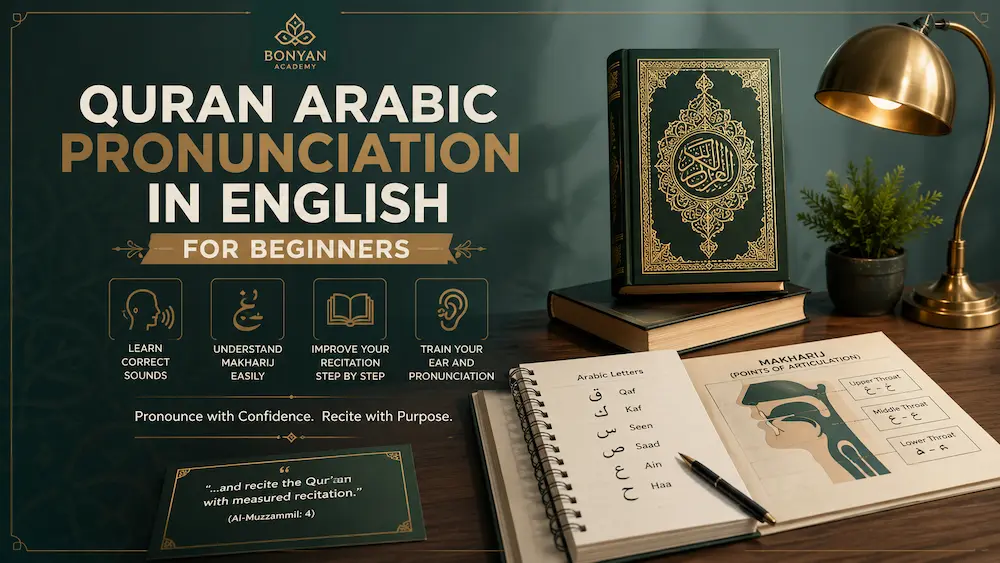
The first step toward reciting the Quran Arabic pronunciation in English with confidence is to learn Quranic Arabic pronunciation in English. English letters can help you to get closer to the right sound, but the letters of Arabic were not designed to represent their throat letters, heavy letters, or the length of their vowels. This guide explains where Quran in English transliteration can be of assistance, where it is ineffective, and how to train your tongue, your ear, and your habits to ensure your recitation.
Why Is Perfecting Your Quran Arabic Pronunciation in English the True Foundation of Worship?
The importance of Quran Arabic pronunciation in english is that it is important to make the right pronunciation of each letter and each word in the Quran because the meaning of a word in your prayer can be different if you make a mistake in pronouncing the letter or the word.
Recitation is not just reading; it is preserving the exact sound Allah revealed to the Prophet Muhammad ﷺ, letter for letter. The Quran itself teaches Muslims to recite by a measured and careful pronunciation, not a hurried and approximate one.
It is a dilemma for an English-speaking Muslim. You want to worship properly, but you never learned the Arabic mouth and throat positions. Transliteration is not the end result, it’s a starting point.
When used properly, it helps you to learn to read words day one, when used as a crutch, it creates habits that are difficult to change later in life. The ultimate objective of the first lesson should be to progress from the use of English letters to real Arabic sounds.
Explore the Best Way to Memorize Quran Fast .
English Letters vs. Arabic Makharij: What Is the Ultimate Strategic Difference for Learners?
| English Letter | Arabic Letters It’s Forced to Cover | Real Makhraj | Common Learner Mistake |
|---|---|---|---|
| H | ه, ح | Lower throat vs. middle throat | Treating both as one soft “H” |
| K | ك, ق | Back of tongue vs. deep throat | Flattening ق into a regular K |
| S | س, ص | Tip of tongue vs. tongue pressed for a heavy S | Losing the heaviness of ص |
| D | د, ض | Front teeth vs. side of tongue pressed to molars | Dropping the emphatic weight of ض |
| ‘ (apostrophe) | ء, ع | Glottal stop vs. deep throat constriction | Skipping ع entirely or softening it to nothing |
Transliteration can only be approximate, since one symbol represents two to three sounds. That’s why the next section is important – those little approximations can turn the meaning of a word.
How Do Small Mistakes in English Transliterations Change Quranic Meanings?
Small transliteration mistakes change Quranic meanings because Arabic is a language built on precise consonants, and swapping one for its closest English look-alike creates a real, different word. This is not a stylistic issue it is a meaning issue, and it is the single strongest argument for moving past transliteration as soon as possible.
A few documented examples show the stakes clearly:
- ق vs ك قلب (qalb, “heart”) pronounced with a flattened English K instead of the deep, back-of-throat ق can shift toward كلب, a completely unrelated word.
- ص vs س the Fatiha’s الصراط (the emphatic “path”) loses its heaviness and can drift toward السراط if the emphatic ص is read like a plain English S.
- ḍ vs d one academic source on Arabic transliteration notes that ḍalālah means “misguidance,” while dropping the emphatic mark and reading it as dalalah shifts it toward “guidance” the near opposite meaning, from one missing dot under the letter.
- Vowel length reading a short vowel as long (or the reverse) changes grammar and tense, turning a statement into a command or a singular into a plural.
None of these errors are due to carelessness but are due to the fact that English letters are missing from Arabic information. That is why the following sections go through the most difficult sound groups, one by one.
Explore more about the Words From Quran With Meaning .
How Can Beginners Pronounce Difficult Arabic Throat Letters Using English?
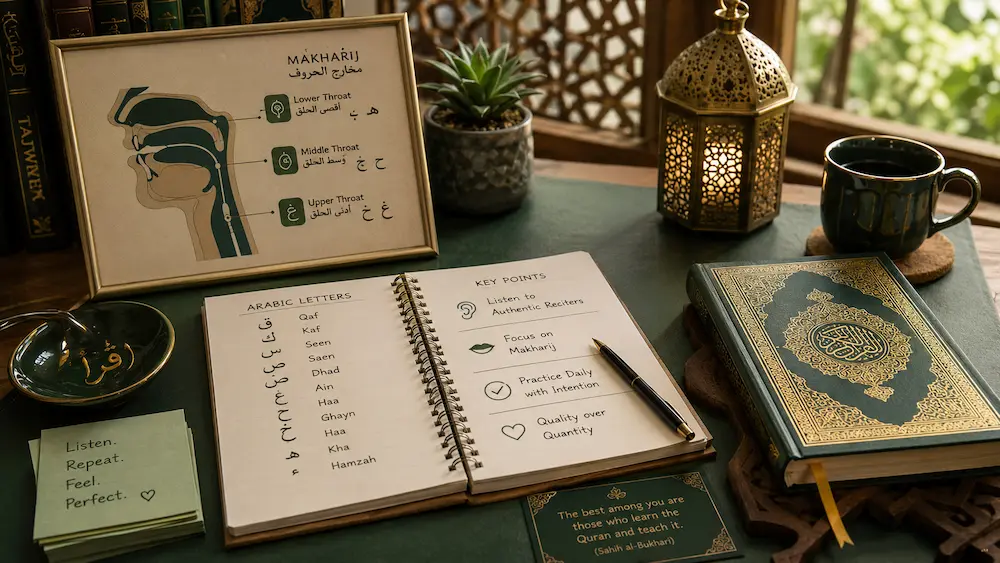
For beginners, approximation of the Arabic throat letters can be done by starting with the English letters, followed by correction of their position through guided feedback: The six throat letters in Arabic (ء ه ع ح غ خ) are derived from three different throat zones in English. The habit is established earlier and years of correction later are avoided.
Here’s a hands-on, step-by-step approach to begin:
- First find the zone: Lower throat (ء, ه) is closest to your voice box; Middle throat (ع, ح) is in the middle of your throat; Upper throat (غ, خ) is closest to your back of your mouth, where you would gargle.
- Learn one letter at a time: Don’t learn all six letters at once start with ح by exhaling with force, like fogging a mirror, but from the middle of the throat, not the mouth.
- To use a mirror and the hand: When you say ع and ح, you should feel a distinct constriction that a plain English “A” or “H” will not produce, as you lightly place your hand on your throat.
- Record yourself every day and listen to it in comparison to another qualified reciter’s tape, not to a second beginner’s tape.
The only way to hear the difference between a throat letter that’s “close enough” and a throat letter that’s correct is to get live correction from a teacher who can hear you.
How Do Vowel Marks Change Quran Arabic Pronunciation in English Texts?
The vowel marks affect the pronunciation of Quran Arabic in English texts because Arabic has short vowels (fatha, kasra and damma) and long vowels (madd letters a, w and y), and the difference is in the grammatical weight of the two with respect to each other, and the transliteration of the quran in english text with arabic pronunciation online often confuses the two into one symbol.
Why Vowel Marks Matter So Much for Quran Arabic Pronunciation in English Readers:
A short vowel is pronounced for about one beat, and a long vowel is prolonged for two or more beats according to the rule of tajweed. There is no style difference between reading “qal” as a short vowel and “qaal” with the proper lengthening, for the latter is grammatically incomplete without its lengthening, and the former changes the form of the word.
Likewise, if you change the end vowel (such as changing a damma into a fatha at the end of a word), this can change a sentence from a statement to a grammatically different sentence.
Since English readers are accustomed to the flexibility and optional nature of vowels, transliterated Quran texts must have consistent, clearly visible marks (a line over a, i, and u for long vowels), and even then, the learner must have a teacher to verify that the vowels are being stretched to the appropriate length and not just read.
Join to our Quran Memorization Course .
How Do Learners Overcome the Common Habit of Rushing Through Vowel Extensions?
By taking the place of “reading speed”, learners eliminate rushed vowel extensions by counting instead because the rules for madd are counted in beats and not feelings. In In English, the long vowels are not sustained, so most English speakers tend to rush through them.
Here are some practical steps to help break this habit:
- First count out loud: When counting 2 count mats, treat them as counting ‘1-2’ in your head and don’t estimate.
- Slow the whole verse down: not just the vowel. If you’re in a hurry with one word, you’re probably rushing with the rest of the line.
- Use a metronome or clapping: to develop an aural sense of beat before reintroducing meaning.
- Learn short Quranic words first before trying to learn whole verses: say, say, says, etc.
One of the most difficult to self-correct is rushed mad, as it is often “normal” to the learner’s own ear.
What Is the Most Effective Step-by-Step Training Method to Break a Western Accent?
The best way is to go through five steps instead of directly to full verses, since a learner’s accent habits develop at a faster rate when reading connected text before individual sounds are mastered.
- Learn isolated letters: Using the mirror and airflow checks mentioned above, get each of the 17 makharij points correct individually before combining.
- Practice minimal pairs: Practice pairs of letters that sound close in English but not in Arabic (e.g., ذ/ز) back to back until the difference is clearly audible to your own ear.
- Short words: Go to 2- and 3-letter words of the Quran (رب,رب, حق, قلقل) without making them too complex.
- Read short surahs slowly: accuracy first, speed second. Al-Fatiha and the last short surahs are good surahs to start with.
- Consistently receive live correction: With a Western accent, it’s the small errors that are constantly repeated and unnoticed, and only a teacher can hear in real time to correct these before they become permanent habits.
Explore the best Arabic Language Course .
How Can Non-Arabic Speakers Practice Heavy Sounds Safely Every Day?
For non-Arabic speakers, the seven heavy letters (خ ص ض ط ظ غ ق) can be safely practiced each day, but at a gradual pace and not too loud or too fast, as these letters involve a raised tongue and back-of-mouth resonance, which may strain untrained voices if used too strongly or too quickly.
- Warm up first: Do not begin cold spend 2 minutes on the regular letters of the alphabet before moving to the heavy letters.
- Emphasize resonance rather than force: The “heaviness” is not due to the need to shout the letter louder, but rather to the position of the tongue and the shape of the mouth.
- Keep sessions short: A few minutes of concentrated work with heavy letters is better than an hour of tense repetition.
- Avoid dehydration and rest: if you notice any tightness in your throat heavy letters should never be painful.
Have a teacher give feedback while practicing at least in the first few weeks to correct incorrect tension before it becomes a physical habit.
What Are the Safest Strategies to Avoid Cognitive Fatigue When Practicing Recitation?
The best approach to not being overwhelmed by cognitive load is to only learn one rule and 10-15 minutes at a time, as the learners of english quran with arabic pronunciation often try to learn makharij, vowel rules, and heavy letters all at once and their progress is hindered by the excessive cognitive load.
Distributing practice over a short period of time daily (not one long session weekly) allows the mouth and ear to form muscle memory between sessions rather than to fatigue.
It also makes the mind active, instead of sounding out sounds, by reflecting on a verse’s meaning. Above all, take breaks between intense letter drills. Vocal fatigue and mental fatigue are cumulative and will often reinforce errors more than correct them.
Explore the best islamic online academy .
Why Is Bunyan Islamic Academy the Perfect Path to Perfect Your Pronunciation?
Unlike static articles or recordings, Bunyan Islamic Academy is designed to fill the gap between the English transliteration and the true Arabic pronunciation by live, one-to-one correction from Al-Azhar-certified teachers. All Tajweed sessions are based on Makharij and Madd correction in real time, meaning that the error is picked up as soon as it occurs, not weeks after it has become a habit.
With 100+ certified teachers and over 80,000 teaching hours, the academy has currently educated over 1,000 students in over 20 countries with a rating of 4.9/5 from over 200 verified reviews on Google and Trustpilot.
For those who are interested in the formal Ijazah chain of transmission, students can also move through a formal Ijazah path. One recent pupil, a nervous convert, was matched with a female scholar and said that from the first session she was completely at ease with her, a kind of correction that is not possible by a self-study transliteration guide.
Ready to improve your Quran recitation with real-time guidance? Book your trial class with Bunyan Islamic Academy and learn directly from qualified teachers who help you correct every detail.
Conclusion
Quran Arabic pronunciation in English is a genuinely useful starting ramp but it was never meant to be the finish line. Real accuracy comes from pairing transliteration with live correction from a qualified teacher who can hear the exact moment a throat letter, heavy letter, or vowel length goes off track , If you’ve been relying on English letters alone, the fastest way forward is a single guided session, not another article.
Book your free trial class with Bunyan Islamic Academy today—no credit card required and you’ll be matched with an Al-Azhar-certified teacher who can start correcting your Quran Arabic pronunciation in English from your very first lesson.
F&Qs
Is it acceptable to pray using only English transliteration without learning Arabic script?
Transliteration can help a new Muslim start reading short surahs for prayer, but scholars generally treat it as a temporary aid, not a permanent replacement. Because Latin letters can’t fully capture Arabic sounds, most teachers recommend transitioning to Arabic script and live-corrected recitation as soon as possible.
How long does it take to move from English transliteration to confident Arabic reading?
Most beginners can start recognizing Arabic letters within a few weeks of consistent, short daily practice, with basic confident reading of short surahs following within a few months. The timeline depends heavily on session frequency and whether a teacher is correcting mistakes live.
Can adults learn Makharij and heavy letters as effectively as children?
Yes, adults often progress faster on technical rules like Makharij because they can consciously understand throat positions and mouth mechanics, something young children usually learn more by imitation. Consistent short sessions matter more than age for this specific skill.
Do regional Arabic dialects affect how Quran pronunciation Arabic should be taught?
Everyday spoken dialects sometimes pronounce certain letters differently, such as ج varying by region, but Quranic recitation follows classical Tajweed rules regardless of dialect. A qualified reciter or teacher trained in classical pronunciation should always be the model, never a dialect-influenced pronunciation picked up casually from conversational Arabic media.
Are diacritic-marked transliterations (with lines over long vowels) accurate enough for beginners?
They’re a meaningful improvement over plain transliteration because they at least flag vowel length, but they still can’t represent throat letters, heavy letters, or the ع sound accurately. They work best as a bridge tool alongside audio and live teacher feedback, not as a standalone method.