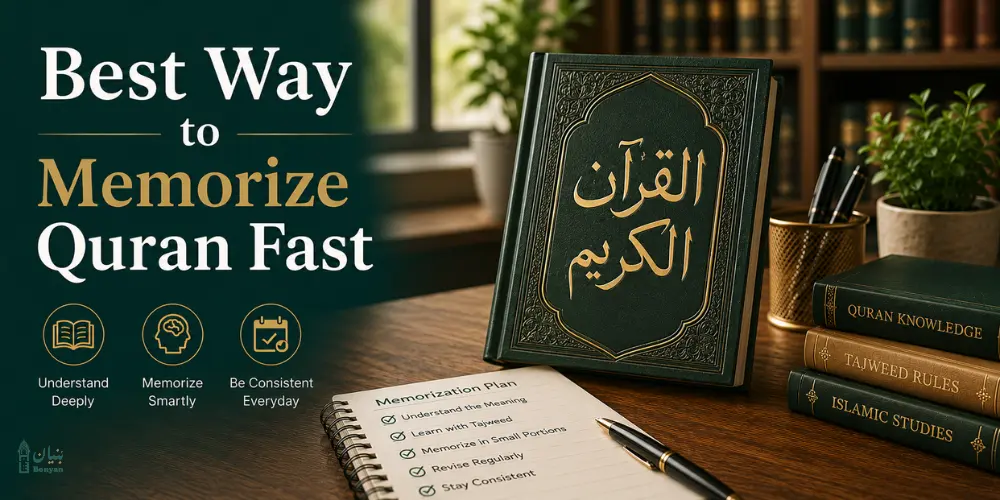
Many students begin hifz with enthusiasm, then lose earlier verses while trying to add new ones. The problem is often not weak memory; it is an unbalanced routine with too much new material and too little revision. The best way to memorize Quran fast is to combine daily memorisation with listening, reciting aloud and returning to older passages. Studying with an online Quran teacher can also protect your pronunciation before mistakes become fixed. Bonyan Academy helps learners build a manageable routine while giving proper attention to Tajweed Quran rules and confident recitation.
What is the best way to memorize Quran fast?
- The best way to memorize Quran fast begins with a sincere intention and a small daily portion. Speed should never come at the cost of correct words, missing letters or weak Tajweed.
- Read the ayahs several times while looking at the mushaf. Then listen to a trusted reciter and repeat each line aloud until the tongue moves through it without hesitation.
- Break a long ayah into short phrases. Learn one phrase, connect it to the next, then recite the whole ayah from memory. This is usually stronger than trying to absorb a full page at once.
- New memorisation needs review on the same day. Recite it after salah, before sleep and again the following morning.
- Studying the Tajweed Quran with an online Quran teacher helps correct pronunciation early. A mistake repeated many times can become difficult to remove later.
- Bonyan Academy supports students who want to memorize Quran through guided lessons, regular correction and a routine suited to their level.
join our Quran Memorization Course
How can I memorize Quran quickly and not forget it?
- Fast memorisation lasts only when new work and review move together. The best way to memorize quran fast is to learn a small section well, then revisit it before adding more.
- Read each ayah from the mushaf, listen carefully, and repeat it aloud until the wording feels settled. Correct mistakes first; repeated errors become harder to remove later.
- Link every new ayah to the one before it. Many learners remember separate lines but lose the order because they rarely practise the transitions.
- Review the new passage after a short break, again later that day, and once more the next morning. This shows whether it has stayed beyond the first memorisation session.
- Using the same quran online recording can help the ear recognise rhythm and stopping points, while a tajweed quran lesson protects pronunciation and letter qualities.
- Bonyan Academy can help learners follow a realistic hifz and revision plan with live correction, so progress is not measured only by how much was memorised today.
Is it better to memorize Quran in the morning or at night?
- Yes, morning is usually the better time for new memorisation, especially after Fajr, when the mind has not yet filled with the day’s noise. That is a practical habit, not a religious condition.
- Night suits some learners better. It can be used to test what was learned earlier, because tiredness quickly shows which ayahs are weak.
- The best way to memorize Quran fast is to keep the same slot and protect it. Ten focused minutes every day often build more than a long session that keeps moving.
- Start with slow Quran recitation from the mushaf. Read the ayah, repeat it in short parts, then join the parts without looking.
- A Quran in English and Arabic may help when the sequence feels confusing. Understanding the subject of the passage can make the order easier to hold.
- Bonyan Academy can help learners choose a realistic time, correct mistakes and build review into the week rather than leaving it until memorisation becomes shaky.
read more about Words From Quran With Meaning for Better Understanding
How many ayahs should I memorize a day?
- Do not begin with a number. Begin with what you can still recite tomorrow. For one learner that may be a single long ayah; for another, it may be four short ones.
- The best way to memorize quran fast is to set a daily limit that leaves room for review. If new memorisation keeps pushing old verses out, the target is too high.
- When you memorize quran, test the passage without looking, then recite it again after a few hours. Any place where you hesitate needs more work before you add something new.
- Some days will be slower. Similar ayahs, unfamiliar words and long endings naturally need extra repetition, so progress should not be judged by page count alone.
- Learners who learn quran online can ask a teacher to adjust the portion each week according to accuracy, Tajweed and retention.
- At Bonyan Academy, the aim is steady hifz: a manageable amount, corrected properly, then reviewed until it stays with you.
What is the best Quran memorization method?
The best method isn’t a single technique, but a combination of five proven elements that work together: repetition, listening, writing, understanding, and teacher correction. The right mix depends on how each learner remembers best, whether through sound, sight, or writing.
Repetition
This is the most common approach. One ayah is read slowly, repeated aloud, then recited without looking. Long ayahs can be divided into smaller phrases before the parts are joined back together.
Listening
This is especially useful for learners who remember rhythm and pronunciation. Sticking with the same reciter until the passage becomes familiar helps build consistency and avoids confusion between different recitation styles.
Writing
Copying ayahs by hand helps with similar verses, unusual spellings, and verse endings, since writing makes small differences easier to notice and remember.
Understanding the meaning
Knowing the general meaning of a passage supports memorization order. When the subject of an ayah is clear, the next one is less likely to feel disconnected from it.
Talaqqi (direct correction from a teacher)
Talaqqi, or learning directly from a qualified teacher, remains essential because a teacher can catch errors a learner may not notice alone, especially in pronunciation and tajweed.
Combining these five elements, rather than relying on just one, is what makes memorization both faster and more reliable.
Can I memorize Quran without understanding Arabic?
- Yes, you can memorise the Qur’an without understanding Arabic. Many learners begin hifz by listening, repeating and following the mushaf before they know the language well.
- Understanding is not a condition for memorisation, but it can make the work easier. When you know what an ayah is discussing, its order becomes less random and similar verses are easier to separate.
- The best way to memorize quran fast is to correct the Arabic reading first. A translation explains the meaning, but it cannot show every letter, vowel or Tajweed rule needed for accurate recitation.
- Using a Quran in English and Arabic helps you connect the words with the message without replacing the original Arabic text.
- You do not need to delay hifz until you learn Quranic Arabic. Study common words and repeated roots alongside your daily portion, little by little.
How do I retain what I memorize in the Quran?
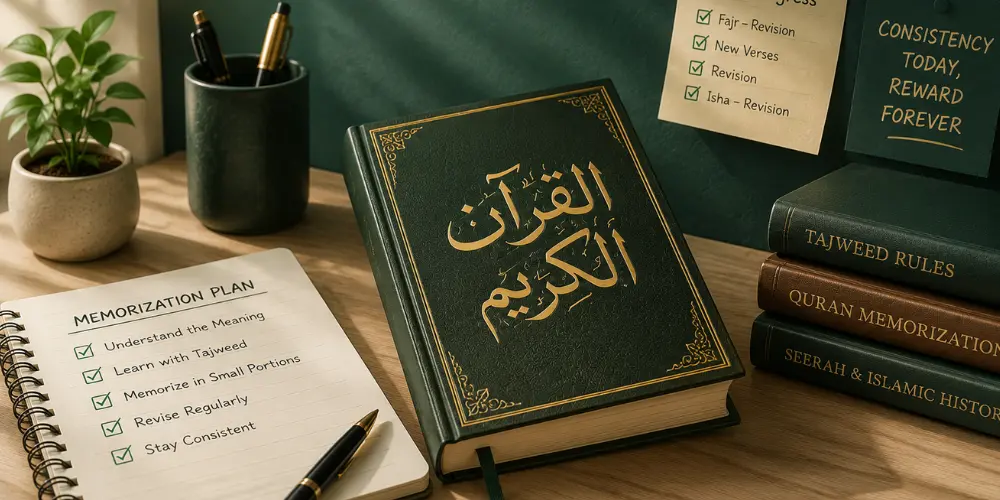
- Retention starts before you close the mushaf. Recite the new passage without looking, then return to every place where the wording, ending or order feels uncertain.
- Review it again later the same day, the next morning, after three days and at the end of the week. These gaps show whether the ayahs are settled or only familiar.
- The best way to memorize quran fast is to keep old hifz moving alongside new work. Do not add another section when yesterday’s portion still breaks under testing.
- Recite connected passages, not ayahs in isolation. Practise the final words of one ayah with the opening of the next, especially where verses sound alike.
- Use your memorised verses in voluntary salah where appropriate, and listen to a Quran recitation to refresh rhythm and stopping points.
- An online Quran teacher can test from unexpected places and note repeated errors. Bonyan Academy helps learners build review around new memorisation, so progress remains firm rather than fast.
read more about Complete Guide on How to Do Sajdah for Quran?
Should I use one mushaf for memorization?
- Yes, using one mushaf is usually better for memorisation. It is not a religious requirement, but it gives the eyes a stable page layout to recognise.
- With time, you may remember that an ayah begins near the top, ends beside a particular line, or continues onto the next page. Changing editions can remove these quiet visual clues.
- Choose a mushaf with clear Uthmani script, comfortable spacing and a size you can use daily. Very small print may make long sessions tiring.
- The best way to memorize quran fast includes keeping the same page numbering and verse arrangement, especially when a teacher refers to pages during lessons.
- Avoid covering the Arabic text with heavy notes. Small, respectful marks beside similar words or difficult stopping places may help, provided the words remain clear.
- A digital mushaf is useful while travelling, but let one printed copy remain your main reference. At Bonyan Academy, students can be guided towards a suitable edition that matches their course and reading level.
How important is review in Quran memorization?
- Review is the part of hifz that turns memorised pages into lasting memory. The Prophet ﷺ warned that the Qur’an can slip away quickly when it is not kept close through recitation.
- Do not review only from the beginning of a surah. Ask someone to start you from the middle, from a similar ayah, or from the end of a page. This shows whether you know the passage or only its opening.
- Keep a list of recurring mistakes: mixed endings, skipped words, weak page links and verses that resemble others. Give those places separate attention instead of repeating strong pages again and again.
- The best way to memorize quran fast is to protect a share of the week for muraja‘ah, even when new lessons are going well.
Can adults memorize the Quran fast?
- Yes, adults can memorise the Qur’an quickly, but “quickly” will not mean the same thing for everyone. Reading fluency, pronunciation, concentration and previous contact with Arabic affect the pace.
- Adults often bring strengths to hifz: self-discipline, clear goals and a better ability to notice meaning, themes and repeated structures across a surah.
- The best way to memorize quran fast as an adult is to begin from your real level. Someone still correcting basic reading should not copy the target of a fluent reciter.
- Use short, demanding sessions rather than waiting for a free hour. Twenty attentive minutes can produce more than a tired evening spent rereading the same page.
- Do not treat slower progress as failure. Hifz is worship, and steady effort still carries value even when age, work or family duties reduce the daily amount.
- Bonyan Academy can assess an adult learner’s recitation, set a suitable starting point and build a hifz plan that respects ability and available time.
read more about Revelation Recording and Memorisation of the Holy Quran
What is spaced repetition in Quran memorization?
- Spaced repetition means returning to memorised ayahs at widening intervals instead of repeating them many times in one sitting. A passage may be checked later that day, then after one, three, seven and fourteen days.
- The interval should change with performance. If an ayah is recited cleanly, leave a longer gap. If words are mixed or prompts are needed, bring it back sooner.
- This method works best when the learner recalls before opening the mushaf. Recognition while looking at the page can feel strong even when independent recitation is weak.
- The best way to memorize quran fast uses spaced repetition as a flexible system, not a rigid timetable. Similar ayahs, long verses and pages with repeated errors need tighter intervals.
- Keep a record with dates and marks such as firm, uncertain or weak. This prevents easy pages from taking revision time.
- Bonyan Academy can schedule these returns, test passages without warning and adjust intervals as the student’s hifz grows.
Do I need a teacher to memorize the Quran?
- No, a teacher is not required before you begin memorising, but learning completely alone can hide mistakes that feel correct because you have repeated them many times.
- A teacher does more than listen to the lesson. They can stop you at an incorrect vowel, notice when two similar ayahs have been mixed, and ask you to continue from places you did not prepare.
- Regular recitation to someone also creates accountability. It is harder to delay hifz for several days when a lesson has a clear time and a portion must be presented.
- Choose an online Quran teacher who listens carefully, explains errors and does not increase the target simply to make progress look fast.
- The teacher should also respect the learner’s ability. Children, working adults and students with weak Arabic reading will not need the same pace or teaching style.
How do I stay consistent with hifz?
- Consistency often breaks when the plan is built for an ideal week rather than real life. Set a weekly target, not only a daily one, so one difficult day does not make everything feel lost.
- Keep two versions of the lesson: a normal session and a reduced one for travel or family pressure. The smaller version might be listening and reciting one old page; hifz remains present.
- Leave one day each week without new memorisation. Use it to tidy weak places, catch up and begin the next week without unfinished work.
- Avoid comparing your pace with others sharing large targets online. The Qur’an is not a public scorecard, and steady private effort may be more sincere.
- Make a short dua before starting, asking Allah for firmness and sincerity. This approach keeps the goal larger than numbers.
read more about Quran Ahkam Tajweed Rules Every Muslim Should Know
What are the easiest surahs to memorize first?
- Start with the short surahs at the end of the Qur’an, especially Al-Ikhlas, Al-Falaq and An-Nas. Their length makes them manageable, and many learners already hear them in salah.
- Al-Kawthar and Al-Asr are also good early choices, but short does not always mean effortless. Similar endings and repeated sounds still need careful attention.
- Al-Fatihah deserves special care because it is recited in every rak‘ah. A learner may know it by habit while still carrying pronunciation mistakes, so correction matters.
- After a few very short surahs, move to a slightly longer one such as Al-Ma‘un or Quraysh. This builds confidence without making the jump feel too large.
- Learn each surah with its basic message. Knowing that Al-Ikhlas teaches Allah’s oneness, for example, gives the words a clearer place in the mind.
- No fixed order is required; difficulty may guide the sequence. Bonyan Academy can help beginners choose a suitable order, correct recitation and move gradually from familiar surahs to longer passages.
How can I memorize Quran with a busy schedule?
- A busy schedule does not need an empty block. Separate hifz into small jobs: listen during travel, mark difficult words at lunch, and save fresh memorisation for the quietest part of the day.
- Prepare tomorrow’s passage the night before. Reading the meaning, checking unfamiliar words and hearing a careful recitation reduces the time lost at the start of the next session.
- Use “dead time”. Five minutes waiting for an appointment can test yesterday’s ayahs, but do not try to learn new verses while driving, walking through traffic or answering messages.
- Keep one longer session each week for joining the week’s portions together. This catches weak transitions that short daily sessions may hide.
- Record yourself once a week. Listening back often reveals rushed vowels, unclear stops and places where confidence is weaker than it felt.
join our online tajweed course
Why Bonyan Academy is the Best hifz Academy?
- Bonyan Academy does not place every student in the same hifz programme. A beginner who still needs reading support can start with Quran Foundation, while a fluent student can enter memorisation or work towards a memorisation ijazah.
- Recitation and memorisation are taught as connected skills. A learner may remember a passage clearly while still carrying mistakes in letters, vowels or stopping places, so both need attention.
- The academy welcomes children and adults, allowing lessons to reflect age, reading level and the amount of help available at home.
- Live teaching gives each student a place to recite, receive correction and leave with a clear next task instead of relying on recordings alone.
- The best way to memorize quran fast works better inside a complete learning path, not as a short challenge.
- By bringing Quran foundation, recitation, memorisation and ijazah study together, Bonyan Academy offers strong support for learners who want their hifz to grow carefully and correctly.
Conclusion
Hifz does not always move in a straight line. Some weeks feel easy, while others need more patience, more review and a smaller target. What matters is returning to the Qur’an and not letting a difficult day become a reason to stop. Bonyan Academy supports learners with live guidance, correction and a plan that can change as their level improves. The best way to memorize quran fast is not to rush through pages, but to learn them properly and keep coming back to them. With sincere intention and steady effort, each verse can remain close to the heart and tongue.
FAQs
Can I memorise the Quran from a mobile phone?
Yes, a phone can be useful when carrying a printed mushaf is difficult. Choose an app with clear Uthmani script, switch off distracting notifications and check that the text comes from a reliable source. The rulings connected with touching a printed mushaf are a separate matter, so learners should follow trusted scholarly guidance.
Should I use transliteration when memorising the Quran?
Transliteration may help a complete beginner recognise a few sounds, but it should not become the main source for hifz. English letters cannot represent every Arabic sound accurately. Depending on them for too long may fix the wrong pronunciation in the memory before the learner notices it.
Can writing Quran verses by hand help memorisation?
Yes, it can help some learners. Writing slows the eye down and draws attention to repeated words, spelling and ayah endings. Copy directly from a checked mushaf and compare the finished line carefully. Papers containing Quranic verses should also be kept and disposed of respectfully.
What should I do after completing a whole surah?
Recite the surah from beginning to end without prompts, then present it to a qualified teacher. Check the difficult words, correct stopping places, and the basic meaning. It is also helpful to use the surah in salah where appropriate, so it becomes familiar outside the lesson setting.