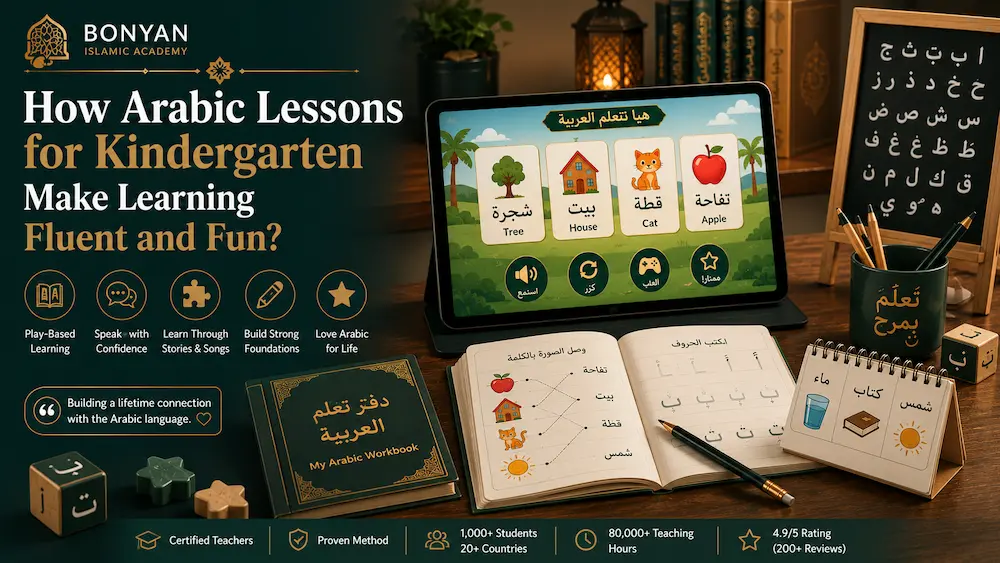
Arabic lessons for kindergarten provide a 3-6-year-old with the best opportunity to learn a new language naturally, by the power of sound, rhythm, and play, not memorization. The brain is easier to absorb unknown letters and phonics at this age than at any later time in a child’s life. This guide helps parents to understand the science of early learning, fun hands-on strategies, key vocabulary, and how Bonyan Islamic Academy makes this window of opportunity a window of progress.
Why is Early Childhood the Best Biological Window to Absorb Arabic?
The early childhood window is best because a child’s brain learns new sounds simultaneously across both hemispheres, whereas an adult’s brain only learns new sounds on one side. Researchers Penfield and Roberts first proposed this idea and it was expanded upon by linguist Eric Lenneberg who believed that language acquisition was most effective between the ages of two and puberty.
This is not something that is hypothetical. The University of Connecticut Kids in Developmental Science research suggests that babies can only recognize the difference between dialects until they reach around four months of age, but after that, they lose the ability unless they practice it.
This early sensitivity is important for Arabic, as there are sounds in Arabic that are not used in English. arabic lessons for kids, not elementary school, take advantage of this constricted biological window when it’s still open.
Explore How to Learn Arabic in English Step by Step .
How Can Arabic Lessons for Kindergarten Make Learning Easy and Fun?
arabic lessons for kindergarten are most successful when they are not classroom drills but fun. The objective is now to be exposed repeatedly, in a joyous way, not to be pressured to perform:
- Story time in Arabic: short, simple stories have vocabulary development and stimulate imagination.
- Labeling objects in Arabic: Home becomes a practice place with Arabic sticky labels on doors, toys, and furniture.
- Role-plays: Kids pretend to shop, order food, or introduce family members to practice speaking skills in a low-key way.
- Songs and movement: rhymes and repetition, along with actions, help sounds to stick without effort.
- Focused, game-based, short sessions: 15-20 minutes of focused, game-based practice is more effective for retention than one long weekly lesson.Free Arabic Lessons for Kindergarten Activities You Can Start Today
Parents don’t have to start in a classroom. All of these are good first steps for building the same listening skills that will be reinforced in a formal course: pointing to objects around the house, naming them in Arabic, singing the alphabet together, or watching a 5-minute Arabic cartoon clip before bed.
How Do You Choose Between Standard Fusha and Spoken Dialects for Kids?
It is up to you to decide whether you want to learn Fusha (Modern Standard Arabic) for reading, writing, and understanding the Quran or a spoken dialect for family conversation. Both are important to an early arabic lessons for kindergarten:
- Select Fusha first: If you are interested in Quran recitations, formal reading, formal writing, or a base that can be used in all Arabic-speaking countries.
- If grandparents or relatives use a particular dialect at home and it is an immediate need, add a dialect along with it.
- Don’t combine them in the same lesson: At this age, young children learn best when the input is uniform you don’t want to change from Fusha to dialect and back again, or else their letter sounds will get confused.
- The split should be based on the long-term goal: families that embed their children in the study of the Quran more likely will focus on Fusha at the beginning, then add conversational dialect over time as it is introduced naturally.
Join our Arabic Language Course .
Why Do English-Speaking Kids Struggle with Arabic Pronunciation?
Several letters in Arabic do not have an equivalent sound in English, which is why English-speaking children have a problem with Arabic pronunciation. Likewise, letters such as ع (ain), ح (haa), ق (qaf), and ض (dhad) are formed in the back of the throat or with tongue positions never mastered by English speakers.
The child can repeat a sound for months without realizing it is incorrect if the teacher is not listening and correcting the sound on the spot.
That is why Arabic for kids learning requires real-time corrections more than other languages that have more common phonetic sounds. If a kindergartener hears the correct Makharij (points of articulation) from day one in short, repeated bursts, they develop accurate muscle memory before a wrong habit has a chance to become a habit that is much harder to break at 15 years old.
How Can Kindergarten Kids Master Arabic Phonics Fast?
The letter-by-letter approach to learning Arabic phonics is the most efficient way for kindergarten students to learn, compared with free-form reading practice. The following is a tried-and-tested way to do it:
- Teach one letter at a time to avoid information overload.
- Follow a known phonics program: Phonics programs such as Noor Al-Bayan use a sequence of letters and vowel marks that are designed for beginner readers.
- Match each letter with a familiar word: Match a letter with an object the child already knows (a fish, a mother, a moon) and lock the sound in his/her mind.
- The repetition across senses (hearing the sound, saying it out loud, and tracing the letter shape together) provides three ways to process the same information.
- New letters are added on the basis of revisiting previous letters: nothing is learned once and forgotten.
Explore the basic arabic lessons for beginners .
How Do Interactive Cartoon Lessons Build Children’s Vocabulary?
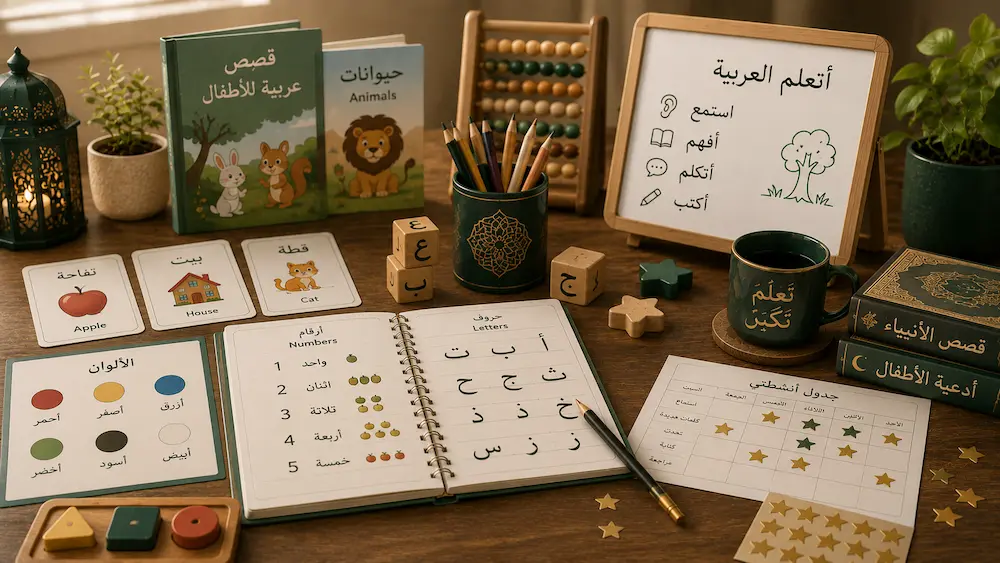
Interactive cartoon lessons teach words in conjunction with a picture and an emotional connection to the word that takes place at the same time that the child hears the word. A repeating word also provides three cues to the brain: sound, image, and story context rather than a single word on a flashcard.
Children naturally re-expose themselves to the same set of words many times when viewing cartoons without it seeming like a “drill.” The repetition is what parents of kindergarten students observe in their home within a few weeks of beginning the screen-based lessons, and it’s for this reason that parents often notice their child using a short Arabic phrase spontaneously at home.
What Essential Arabic Words Should Every Preschooler Learn?
Every preschooler should start with a small, high-frequency word bank before moving to full sentences. A practical starter list covers:
- Greetings: hello, goodbye, please, and thank you.
- Family: mother, father, brother, sister, grandmother, and grandfather.
- Colors: the six or seven most common colors, taught through objects, not flashcards alone.
- Numbers: one through ten, ideally counted aloud during daily routines like snack time.
- Animals: cat, dog, bird, fish high-interest words that show up in almost every children’s story.
- Everyday objects: water, food, book, toy words a child uses multiple times a day.
Mastering this core list gives a kindergartener enough working vocabulary to start forming two- and three-word phrases, which is the natural next step after single-word recognition.
Read more about Words From Quran With Meaning .
How Can Non-Arabic Speaking Parents Teach Their Children?
Parents who do not speak Arabic can also be involved in early learning at home through the management of the early learning environment:
- Structured course with certified teacher: pronunciation & grammar accuracy cannot be provided by a parent.
- Use labels, songs, and apps at home: Parents do not require fluency to press play on a song or to point to a labeled object.
- Request a basic home practice sheet from the teacher: A short list of words/phrases, one per week, allows the parent to oversee practice without needing to know Arabic.
- Sit in on sessions when possible: even if the parent doesn’t know all the words, the interest of a parent to be present is a great motivator for a young child to continue to engage.
- Praise small successes verbally: If the parent doesn’t know the word perfectly, say positive things about it so that kids feel confident to try.
How Do You Build a Fun Daily Arabic Learning Routine?
By tying short Arabic practice to an existing daily activity, you create a fun daily routine instead of a new item on your list:
- Any scheduled time of the day can be used as a consistent time e.g. breakfast, bath time, car journey to school, etc.
- Create short sessions of 10-15 minutes and long beats of 2 minutes or more with breaks in between for a kindergarten’s attention span.
- A song one day of the week, a story another day, a labeling game another day make the routine not so repetitive!
- Practicing with a sibling or parent makes a solo practice a motivating activity.
- Building momentum for tomorrow – ending each session on a win with a word the child already knows well.
Explore the best islamic online academy .
Online Arabic Lessons for Kindergarten Versus Hands-On Workbooks Comparison:-
Printed Arabic workbooks or Kids Arabic learning website lessons for kindergarten addresses various problems, and most families end up utilizing everything. The table below shows where each format really provides:
| Factor | Online Live Lessons | Workbooks Alone |
|---|---|---|
| Real-time pronunciation correction | Yes teacher hears and corrects live | No mistakes can go unnoticed |
| Speaking practice | Built in, every session | None reading and writing only |
| Engagement for short attention spans | High interactive, teacher-led | Depends entirely on parent involvement |
| Consistency of method | Structured curriculum, sequential | Varies by workbook publisher |
| Cost over time | Ongoing monthly investment | One-time purchase, lower cost |
| Best used for | Listening, speaking, accurate phonics | Letter tracing, independent reinforcement |
The downside: The practical byproduct is that workbooks work well as tools to practice the correct pronunciation of the letter between sessions, but they simply cannot correct a mispronounced letter, which is most important in the very first kindergarten years.
Join our Quran Memorization Course .
Why Bonyan Islamic Academy is Your Perfect Partner for Early Arabic Learning ?
The Arabic Language Course for Bonyan Islamic Academy is a great facilitator for early Arabic learning, as it is based on the Noor Al-Bayan phonics method, and the teachers are Al-Azhar-certified with specialization in teaching Arabic as a second language.
This academy has taught 1,000+ students in over 20 countries, with over 80,000 hours of live teaching and a 4.9/5 rating from over 200 verified reviews on Google and Trustpilot.
Every family receives a monthly progress report, listing separately in the report for the month listening, speaking, reading, and writing skills, giving parents a clear overview of what their child is doing without being “guessed.” Starting age and readiness vary by child.
so Bonyan has a free placement trial session, no credit card required, to help the child know exactly where he or she is starting and to see if it’s the correct place for a young beginner.
Conclusion
The best approach to Arabic lessons for kindergarten is to use the right time which allows for easy absorption of sounds, and then practice them consistently, playfully and properly guided. The most powerful single intervention a parent can make is to provide correct pronunciation in the early stages and before habits develop, and not workbooks or apps.
Give Bonyan Islamic Academy a call today to book that free trial class and watch how a certified teacher can make a 15-minute Arabic classes for kids online a day a proven learning experience for your child.
F&Qs
What is the best age to start Arabic lessons for kindergarten?
Children ages 3 to 6 get the most benefit, since this is when the brain is naturally wired to absorb new sounds and letters with the least effort. Starting during this window makes correct pronunciation easier to build than correcting it later.
How long should an Arabic lesson be for a kindergartener?
Short and frequent works best — around 15 to 20 minutes of focused, game-based practice, two to three times a week. Long sessions lose a young child’s attention before real learning happens.
Do parents need to speak Arabic to support their child’s lessons?
No. Parents can support learning without speaking Arabic themselves by managing the home environment — playing songs, using labeled objects, sitting in on sessions, and reinforcing whatever short phrase list the teacher sends home each week.
Should my child start with Fusha (Modern Standard Arabic) or a spoken dialect?
It depends on the family’s goal. Fusha is the better starting point for reading, writing, and Quran recitation, while a dialect makes more sense if a specific dialect is spoken at home. The two shouldn’t be mixed in the same early lessons, since consistent input helps a young child’s pronunciation stay accurate.