Most beginners do not give up because Arabic is impossible. They usually stop because the first lessons contain too many letters, rules, and unfamiliar words at the same time. A better way to learn arabic in english step by step is to study one small skill, practise it properly, and then build on it. For a Muslim learner, even simple progress matters. Words heard in Salah, daily duas, and Quran recitation slowly begin to make sense. Bonyan Academy provides guided Arabic classes where English-speaking students can learn at a steady pace and receive help when something is unclear.
What is the best way to learn Arabic step by step?
- The best way to learn arabic in english step by step is to begin with a clear purpose. A Muslim learner may want to understand Salah, recognise Quranic words, or speak with Arabic-speaking relatives.
- Start with letter sounds, then read each letter inside short words. Arabic letters change shape by position, so memorising the alphabet alone is not enough for real reading.
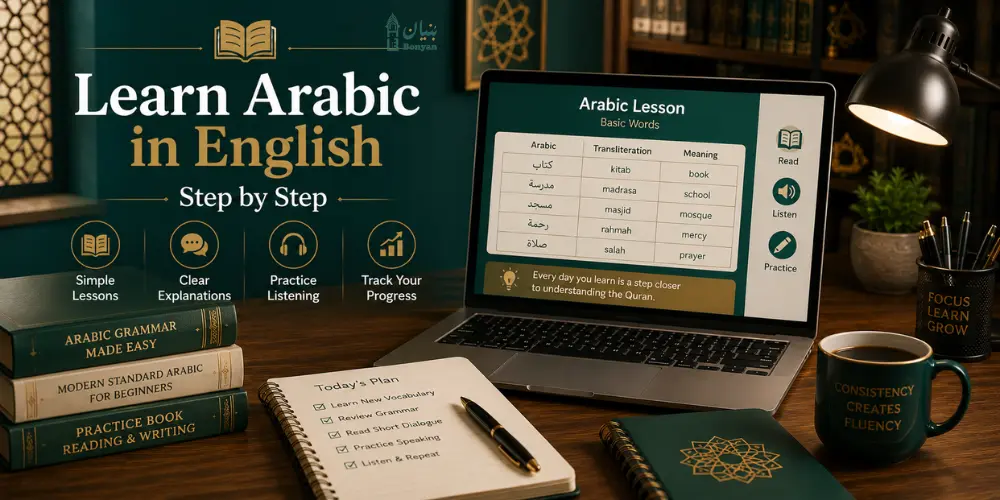
- Keep early vocabulary practical and useful. Words such as رحمة, صلاة, كتاب, and مسجد are easier to remember when their meanings are explained and used in simple sentences.
- Bring in grammar only when it answers a real question. Pronouns, gender, and basic word order are useful early, while long verb tables can wait.
- Anyone choosing to learn arabic online needs direct correction, especially with ع, ح, خ, and ق. These sounds are difficult to judge without hearing a teacher.
- Strong arabic classes should mix reading aloud, listening, revision, and short speaking tasks. Progress comes from meeting the same words in different situations, not from rushing through topics.
join our Arabic Language Course
What Arabic Beginners Need to Know First?
- Before trying to learn arabic in english step by step, it helps to know that reading and understanding are not the same skill. You might read a line correctly but still need vocabulary to know what it says.
- Arabic letters change shape when they join. This looks confusing at first, yet the change is usually small. Reading short words such as مسجد, كتاب, and رحمة makes these forms easier to recognise.
- The vowel marks matter. A fatḥah gives a short “a” sound, a kasrah gives “i”, while a ḍammah gives “u”. Beginners’ books show them clearly, although most everyday Arabic texts leave many of them out.
- Some sounds need patient practice. ح is not the English “h”, and ع has no direct English equivalent, so written pronunciation guides alone are not enough.
- Quranic Arabic Explained lessons should help learners notice recurring words and structures without treating a simple translation as full tafsir.
- Reliable arabic language classes also explain whether a student is learning for Quran study, formal reading, conversation, or a mixture of these goals.
Can English speakers learn Arabic easily?
- Yes, English speakers can learn Arabic, but the first weeks may feel slow because the script, sounds, and sentence patterns are all new at once.
- The alphabet is usually less difficult than learners expect. The real challenge is recognising letters after they join. A letter such as ع looks different in عِلْم and مَعَ, although its basic sound stays the same.
- English spelling habits can also cause pronunciation errors. Writing “rahman” does not teach the proper ح sound in الرحمن, so beginners need to hear Arabic rather than depend on transliteration for too long.
- To learn arabic in english step by step, students should compare the two languages only when the comparison helps. Arabic often leaves out the present-tense verb “to be,” so أنا مسلم literally reads “I Muslim,” although English requires “I am Muslim.”
- Quranic Arabic Explained lessons give religious vocabulary a proper context, while arabic language classes help learners practise reading, grammar, and spoken responses instead of memorising translated words alone.

Do I need to learn the Arabic alphabet first?
- Yes, learn the Arabic alphabet first, but do not spend months copying isolated letters before reading anything meaningful. Recognition should develop alongside sound, short words, and guided recitation.
- Begin with the letters that look similar, such as ب, ت, and ث. Their dots change the sound, so training the eye to notice these details prevents later reading mistakes.
- Learn special forms early. The hamzah may appear alone or above and below another letter, while ة is usually read as “ah” at a pause and as “t” when connected grammatically.
- Muslim learners should also notice the difference between learning the alphabet and learning Tajweed. Knowing letters allows you to read; Tajweed teaches how Quranic letters are pronounced during recitation.
- To learn arabic in english step by step, practise letters inside familiar words from Salah and daily worship rather than using random examples only.
- Students who learn arabic language online should choose arabic lessons online that include live reading correction, since silent worksheets cannot reveal whether each sound is being produced accurately.
join our Tajweed Quran Online
Is Modern Standard Arabic or dialect better for beginners?
- Modern Standard Arabic is the safer first choice for most beginners. It gives the learner access to books, course materials, formal talks, news, and written communication across the Arab world.
- Dialects serve a different need. Someone moving to Egypt may need Egyptian Arabic, while a learner speaking regularly with relatives from Jordan may gain more from Levantine Arabic. A dialect becomes useful when there is a real community in which to use it.
- For Muslims, formal Arabic also supports later study of Quranic vocabulary, hadith texts, and Islamic lessons. It should not be presented as identical to Classical Arabic, but the distance between them is smaller than the distance between the Quran and everyday dialect.
- Students who learn arabic in english step by step can study formal Arabic as their main foundation while keeping a small set of spoken expressions for natural conversation.
- A thoughtful arabic course for english speaking students should ask about the learner’s purpose first. People who learn arabic in english for worship and study usually need a different balance from those learning mainly for travel.
How long does it take to learn Arabic?
- The time needed to learn Arabic depends on what “learn” means to you. Reading from a beginner book is one stage; following a Quran lesson without constant translation is a much later one.
- Learning arabic as an english speaker should be measured in active study hours, not calendar months. Someone who practises for twenty minutes every day may move ahead of a learner who attends one long lesson and does nothing between classes.
- Reciting a memorised surah does not automatically mean that every word is understood. Comprehension grows when vocabulary, sentence endings, and the purpose of each expression are studied together.
- A sensible course checks progress at small points: Can you recognise a verb? Can you follow a teacher’s simple instruction? Can you explain the meaning of a familiar Quranic phrase?
- To learn arabic in english step by step, the pace should change when a weak area appears instead of pushing into a new unit.
- At Bonyan Academy, guided lessons can help students follow a pace suited to their reading ability, Islamic goals, and available study time.
read more about Online Hifdh Program for Kids Adults and Sisters
Learn Basic Arabic Grammar Without Overload:
- Do not begin Arabic grammar with long definitions. Start with sentences you already hear, such as الحمد لله or الله غفور, then notice what each word is doing.
- Learn how a noun becomes definite with ال, because this small change appears constantly in Quranic Arabic and can affect which adjective belongs to which noun.
- Pay attention to simple verb changes. كتب means “he wrote”, while كتبت may mean “she wrote” or “I wrote”. The surrounding words help decide which meaning is intended.
- Questions are useful too. Words such as من, ما, أين, and كيف allow beginners to understand and form complete sentences quite early.
- When you learn arabic in english step by step, keep a small grammar notebook. Write one rule, one Quranic or Islamic example, and one sentence of your own.
- Good arabic language classes should return to the same rule in reading and speaking. A rule is not truly learned just because its name has been memorised.
Can I learn Arabic online by myself?
- Yes, you can learn Arabic online by yourself, but self-study is more suitable for some parts of the language than others. Vocabulary, handwriting, and basic reading can be practised alone with good materials.
- Pronunciation is harder to judge without another person listening. A learner may repeat a sound incorrectly for weeks and still believe it is accurate, especially with letters that come from the throat.
- Muslim students should also keep Quran reading separate from personal language practice. Understanding a word’s basic meaning does not give someone the authority to interpret a verse without tafsir and scholarly context.
- To learn arabic in english step by step, set a small weekly target, such as reading one short passage or understanding five sentences without translation.
- People who learn arabic online should record themselves occasionally and compare their reading with a reliable teacher’s model.
- Live arabic lessons online remain useful at key stages because correction saves time, particularly when reading Quranic text, forming sentences, or moving beyond beginner material.
read more Quran Tajweed With English Translation for Beginners and Adults
How do I start speaking Arabic as a beginner?
- Begin with language you can use that same day. Say your name, where you live, what you study, and why you are learning Arabic. This gives speaking practice a real purpose.
- Keep a small “speaking bank” of ten useful sentence frames. For example, أنا أريد…, عندي…, ذهبت إلى…, and لا أفهم…. Change one part each time instead of building every sentence from nothing.
- Speak through familiar Muslim routines. Describe the steps of wudu, ask about the prayer time, mention an Islamic class, or explain what you read after Salah. The subject is already known, so your attention stays on Arabic.
- While trying to learn arabic in english step by step, allow short pauses. Speaking slowly and choosing the right word is better than rushing into English.
- Ask a teacher to correct one or two repeated mistakes at a time. Too much correction can stop a beginner from speaking freely.
- At the end of each week, speak for one minute on the same subject again. The difference will show which words have become usable.
Should I learn Arabic grammar before speaking?
- No, you do not need to master Arabic grammar before you begin speaking. Waiting until every rule feels clear usually delays the part of learning that builds confidence and recall.
- Learn only the grammar that helps you say something useful. Personal pronouns, simple negation, question words, and the difference between “I want” and “I wanted” are enough for many early conversations.
- Keep grammar tied to meaning. Instead of memorising a full verb chart, practise one form in several situations: أريد أن أقرأ, أريد أن أتعلم, and أريد أن أفهم.
- For Muslim learners, short exchanges about prayer times, attending a lesson, visiting the mosque, or reading Quran can provide natural speaking practice without turning sacred text into casual exercises.
- As you learn arabic in english step by step, notice repeated mistakes after speaking. That is often the right moment to study the rule behind them.
- A teacher should correct errors that change meaning first, then work gradually on smaller points. Speaking and grammar should grow together, not compete with each other.
What is the difference between Quranic Arabic and spoken Arabic?
| Point | Quranic Arabic | Spoken Arabic |
|---|---|---|
| Main purpose | Quranic Arabic was revealed in a highly precise form of Classical Arabic. A change in word order, pronoun, or verb form may add emphasis that is easy to miss in an English translation. | Spoken Arabic is built for quick daily use. The main aim is to understand the other person and respond naturally. |
| Sentence structure | A learner may meet omitted words understood from context, unusual sentence order, and expressions that need reliable tafsir for fuller explanation. | People often shorten expressions, rely on shared context, and do not always follow formal grammar in ordinary conversation. |
| Vocabulary and dialects | The vocabulary belongs to the Quranic text and needs to be read within the verse, grammar, and wider meaning. | Many everyday words belong to a particular town or country, so understanding one dialect does not always mean understanding another. |
| How it is studied | Vocabulary alone is not enough. Learners need reading, grammar, context, and careful explanation from trusted teachers and tafsir. | Conversation improves through listening, speaking, repetition, and exposure to the dialect people actually use. |
| Best learning approach | To learn Arabic in English step by step, study Quranic Arabic as its own track, even when some vocabulary overlaps with everyday Arabic. | Treat conversation as a connected but separate track with its own listening and speaking materials. |
How can I practice Arabic every day?
- Attach Arabic to things you already do. Read the date in Arabic, name objects around the room, or describe what you are preparing for breakfast. This turns practice into part of the day rather than another task waiting on a list.
- Keep one short audio clip for several days. Listen once for the general meaning, again for individual words, then repeat the sentences without looking at the text.
- After Salah, choose one familiar word from the recitation and check where else it appears in the Quran. Write down the verse reference and a brief meaning from a reliable source.
- Use new vocabulary before it disappears from memory. A word becomes more useful when you write it in a message, say it aloud, and meet it again while reading.
- To learn arabic in english step by step, spend a few minutes on different skills across the week instead of forcing reading, writing, listening, and speaking into every session.
- End the week by reviewing what still feels uncertain. Repeated mistakes often show exactly what the next lesson should cover.
read more Words From Quran With Meaning for Better Understanding
How to Keep Progressing After the Basics?
- Reaching the end of a beginner book does not mean the foundation is secure. Before moving on, check whether you can use older vocabulary without reopening the lesson each time.
- Begin noticing how Arabic changes according to the setting. The wording used in a khutbah, a children’s story, and a casual conversation will not sound exactly the same.
- Keep a page for expressions rather than single words. Write down useful combinations as you meet them, especially phrases connected to worship, manners, family, and study.
- Read aloud from material that suits your level, then mark the places where your voice slows down. Those pauses often reveal weak word recognition rather than weak pronunciation.
- As you learn arabic in english step by step, start answering simple comprehension questions in Arabic, even when the answer is only one sentence.
- Study should also become more selective. Do not add new material every day. Some weeks are better spent strengthening what you already know until it becomes easier to recall and use.
Conclusion
You can spend months moving between videos, apps, and scattered notes and still feel unsure about what to study next. A clear course changes that. Bonyan Academy gives English-speaking learners a practical way to learn arabic in english step by step, with lessons that support reading, speaking, and a better understanding of the Arabic used in the Quran and Islamic study. Begin at your real level, learn with a teacher who can correct you, and build from one lesson to the next. Visit Bonyan Academy and start learning Arabic with a clear, structured plan you can actually follow.
FAQs
Is transliteration helpful when learning Arabic?
It can help for a few days, especially when a learner is still getting used to unfamiliar sounds. The problem begins when it becomes a permanent crutch. Words written as “sabr” or “rahmah” do not show the Arabic pronunciation accurately, so the learner should start reading صبر and رحمة as early as possible.
Why are Arabic words written differently in some English books?
There is no single English system for writing Arabic sounds. The letter خ may appear as “kh”, while ق may be written as “q” or sometimes “k”. These spellings are only approximations. They should not be treated as a substitute for learning the original Arabic word.
Do I need to practise Arabic handwriting?
Yes, even when most lessons take place online. Writing by hand helps the learner remember where a letter begins, how it connects, and which dots belong to it. Five carefully written words are more useful than filling several pages without checking the shapes.
Why does one Arabic word sometimes have several plurals?
Arabic does not form every plural by adding one fixed ending. Some words use regular endings, while others change inside the word itself. For example, كتاب becomes كتب. These forms are best learned with the noun rather than left for a separate grammar list.