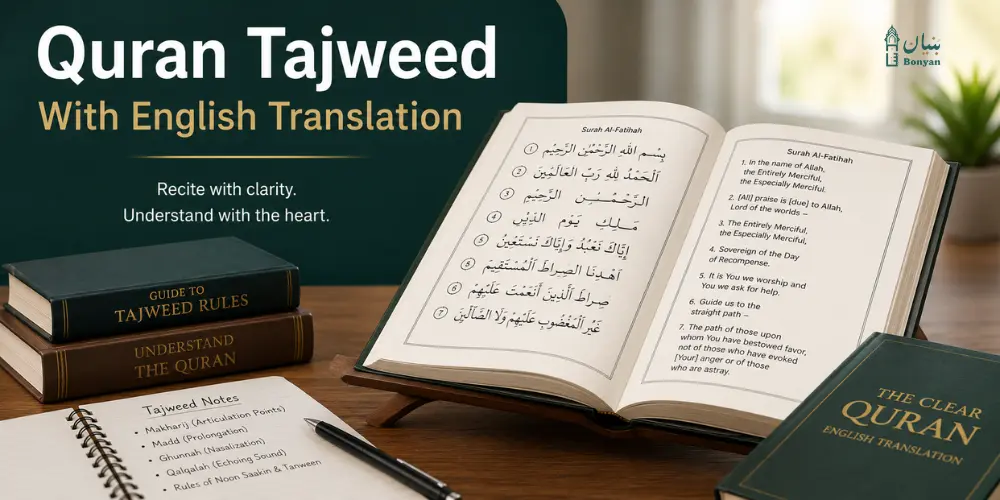
The Quran should be recited with care, but many students need support to understand both the sound and the meaning. Learning quran tajweed with english translation gives the reader a practical path: Tajweed improves pronunciation, and English translation helps the heart follow what the tongue is saying. Some learners also use a colour coded tajweed quran with english translation to recognise rules visually. With Bonyan Islamic, students can learn these rules in a guided way, without turning Quran study into a confusing task.
How to Learn Quran Tajweed with English Translation?
- Start with the Arabic letters first, because Tajweed cannot be strong if the learner still confuses sounds like ح, هـ, ع, أ, ق, and ك.
- Use quran tajweed with english translation to connect recitation with meaning, so the tongue learns the sound while the heart follows the message.
- A beginner should study letter exits, heavy and light letters, madd, ghunnah, and stopping rules before moving into long recitation.
- Quran with English translation helps the learner understand the verse, but it does not show exactly how each letter should be pronounced.
- This is why teacher correction matters; small mistakes in makharij can stay hidden when a student only reads alone.
- Some learners benefit from an english tajweed quran, especially when colour signs guide the eye toward rules during practice.
- The best routine is short daily recitation, listening to a skilled reciter, then reading to a teacher for correction.
Read more about Can you read quran without tajweed ?
The Complete Beginner’s Guide to Quran Tajweed:
- Many beginners think Tajweed is only about reading beautifully, but its real purpose is to protect the sound of the Quran as it was passed down through careful recitation.
- The first step is listening. Before rules and names, the learner needs to hear how letters come from the throat, tongue, lips, and nose.
- Letters like ع, ح, ق, ص, and ض often need patient correction, because they may sound close to easier letters for non-Arabic speakers.
- After pronunciation becomes clearer, the learner can start noticing simple rules such as madd, ghunnah, qalqalah, heavy letters, and stopping at the right place.
- Studying quran tajweed with english translation helps the student understand what is being recited, not only how the words sound.
- A Quran with English translation can explain the message, while tajweed quran transliteration may support early reading, especially for new learners.
- Still, an english tajweed quran works best with a teacher, because Tajweed mistakes are often heard before they are seen on the page.
Best Courses to Learn Quran Tajweed:
- A good Tajweed course should not begin with too many rules at once. It should first check how the student pronounces Arabic letters.
- The teacher needs to listen carefully, because mistakes in letters like ع, ح, ق, ص, and ض are not always clear to the learner.
- For non-Arabic speakers, a course that includes quran tajweed with english translation is usually easier, because the student understands the ayah while improving recitation.
- The best courses include live correction, not only recorded videos, since Tajweed depends on sound, timing, breath, and mouth position.
- Some students also use a Quran with English translation during revision, especially when they want the meaning to stay present.
- A course may suggest tajweed quran transliteration at the beginning, but it should slowly move the learner towards Arabic reading.
- The right course is the one that builds steady recitation, confidence, and respect for the Quran without rushing the student.
join our Tajweed Quran Online
Top Tajweed Quran Books with English Translation and Transliteration:
- The best Tajweed book for a beginner is not always the biggest one. It is the book that helps the learner read, listen, and correct mistakes without feeling lost.
- A colour-coded Tajweed layout can be helpful because the student begins to notice madd, ghunnah, ikhfa, idgham, and qalqalah while reading the page.
- A book with quran tajweed with english translation is useful for non-Arabic speakers, because the learner can follow both the sound and the meaning of the ayah.
- Transliteration may help at the beginning, especially for reverts or children, but it should be treated as support, not the main way to read Quran.
- English letters cannot carry every Arabic sound properly, especially letters like ع, ح, خ, ص, ض, ط, ظ, and ق.
- A good Tajweed book should include the Arabic text clearly, simple Tajweed markings, English meaning, and short notes that explain the rule without making the page crowded.
- Books are good for practice at home, but the student still needs a teacher’s ear, because many Tajweed mistakes are heard before the learner can notice them alone.

Can You Learn Quran Tajweed Online?
- Yes, Quran Tajweed can be learned online when the class includes real listening, direct correction, and a teacher who notices how each letter is coming out.
- The student may understand a rule on paper, but Tajweed only becomes clear when the sound is tested in recitation, especially with madd, ghunnah, and qalqalah.
- Online learning is useful for reverts, busy parents, and non-Arabic speakers who need flexible lessons without losing regular contact with a teacher.
- Studying quran tajweed with english translation also helps the learner follow the meaning of the ayah while improving pronunciation step by step.
- Recorded lessons can support revision, but they are not enough alone because mistakes in makharij, breath, or stopping often need a teacher’s ear.
- A good online routine is simple: listen first, recite slowly, receive correction, repeat the same passage, then practise a little every day.
Read more about Complete Guide on How to Do Sajdah for Quran?
Quran Tajweed with English Translation vs. Arabic Only Tajweed:
| Point | Quran Tajweed with English Translation | Arabic Only Tajweed |
|---|---|---|
| Who may prefer it | This suits a learner who reads slowly and still wants to understand the meaning alongside the Arabic text. It is especially helpful for new Muslims and non-Arabic speakers. | This suits someone who already reads Arabic comfortably and wants to focus more on pronunciation, articulation points, and fluency. |
| Meaning while reading | Quran Tajweed with English translation helps the learner understand the meaning of each ayah, making recitation feel more connected to reflection and worship, not just reading. | The student may recite well, but meaning can stay separate unless they study translation or tafseer in another lesson. |
| Tajweed correction | It helps build awareness of pronunciation, but English translation does not correct Arabic articulation points like ع, ح, ص, ض, ط, or ق. Teacher guidance is still important. | It gives stronger space for makharij, madd, ghunnah, stopping, and repeated oral correction. |
| Main weakness | Some learners may rely too much on English meaning and delay direct immersion in Arabic reading. | Some learners may improve pronunciation but still feel less connected to the deeper meaning of the Quran. |
| Best use | Good as an early bridge between meaning and recitation. | Better once Arabic reading is stable and the student is ready for deeper Tajweed work. |
How Color-Coded Tajweed Quran with English Translation?
- A colour-coded Tajweed Quran helps the learner see some rules on the page before the tongue applies them in recitation.
- For beginners, colours can point to common rules such as madd, ghunnah, ikhfa, idgham, and qalqalah without searching through long explanations.
- When using quran tajweed with english translation, the student can follow the meaning of the ayah while noticing where the sound needs stretching, merging, or nasalisation.
- A common question is: What are the 4 rules of Tajweed? Many teachers begin with pronunciation points, elongation, noon/meem rules, and stopping rules.
- A copy like the holy quran with colour coded english transliteration may help early learners, especially reverts, but it should not replace Arabic reading.
- The real benefit appears when colour, meaning, listening, and teacher correction work together in one steady learning routine.
The Best Tajweed Quran for Reverts and New Muslims:
- The best Tajweed Quran for a new Muslim should feel clear from the first page, not crowded with too many symbols, notes, and rule names.
- A revert usually needs three things together: readable Arabic, simple Tajweed help, and a meaning they can follow without stopping every few words.
- quran tajweed with english translation is useful here because it lets the learner connect the sound of recitation with the message of the ayah.
- Colour-coded letters can help in early practice, especially with stretching, nasal sounds, and letters that need extra attention.
- Transliteration may help for a short time, but it should not become the main way of reading because Arabic sounds are more precise.
- A good copy should also have clear spacing, readable font size, and translation that is easy to understand during slow recitation.
- For reverts, the strongest progress usually comes from using the mushaf with a teacher who listens, corrects gently, and explains without pressure.
Read more about Quran Hifz Classes Near Me for Ladies With Female Teachers
Step-by-Step for Learn Quran Tajweed:
- Start with careful listening before reading long passages. Tajweed is learned by the ear first, because the student needs to hear the difference between a plain sound and a corrected Quranic sound.
- Practise the Arabic letters one by one, especially throat letters and heavy letters, because weak makharij can affect many verses later.
- Move slowly into short rules like madd, ghunnah, qalqalah, and stopping, instead of trying to memorise every Tajweed term at once.
- Use quran tajweed with english translation during practice, so the learner understands the ayah while improving the way it is recited.
- Read a small portion to a teacher, then repeat the same part after correction until the tongue becomes more comfortable.
- Keep a simple notebook for common mistakes, such as stretching too little, merging incorrectly, or stopping in the wrong place.
- The best progress comes from short daily recitation, patient correction, and returning to the same verses until the sound becomes steady.
7 Reasons to Choose Bonyan for online tajweed course with certificate:
- Bonyan Islamic starts with the learner’s real recitation, not with a fixed lesson that assumes everyone has the same level.
- The teacher listens before explaining, because a Tajweed issue may come from the throat, tongue, lips, or timing of the sound.
- A student who mixes letters like ع, ح, ق, ص, or ض needs patient correction, especially if Arabic is not their first language.
- The lesson moves in small steps: clear letters first, then short rules, then smoother reading from the Quran.
- Students read aloud often, so they do not only understand the rule, but hear how it works in an actual ayah.
- Rules like madd, ghunnah, qalqalah, and stopping are easier when they are taken from real recitation, not memorised as separate terms.
- The course suits adults, children, reverts, and busy learners who need regular guidance without feeling judged for mistakes.
- Over time, the student becomes calmer while reading, notices mistakes faster, and feels more connected to the words of Allah.
Explore our Quran Memorization Course
Quran Tajweed with English Translation Online Classes vs. Physical Books:
| Point | Online Classes | Physical Books |
|---|---|---|
| Main value | Online classes give the learner direct correction, which matters because Tajweed mistakes are usually heard before they are understood. | Books give structure and calm revision, especially when the student wants to review rules without waiting for class time. |
| Pronunciation | A teacher can notice weak makharij, rushed madd, unclear ghunnah, or wrong stopping during live recitation. | A book can show the rule, but it cannot hear whether the student is applying it correctly. |
| Flexibility | Good for busy adults, reverts, children, and learners who need lessons from home. | Good for quiet study, marking notes, and returning to the same page many times. |
| Learning depth | Online learning works better when the lesson includes listening, reciting, correction, and repetition. | Physical books work better as support material, not as the only way to learn Tajweed. |
| Best choice | Use classes for correction and confidence. | Use books for review and steady practice. |
How Long Does It Take to Learn Quran Tajweed?
- There is no fixed time for learning Tajweed, because every student starts from a different place.
- A learner who already reads Arabic may only need to fix sound, rhythm, and stopping.
- Someone who still struggles with letters like ع, ح, ق, ص, or ض will need more time at the beginning.
- The first weeks are usually about listening well and noticing mistakes the student did not hear before.
- After that, rules such as madd, ghunnah, qalqalah, and stopping become easier to practise.
- One short daily session is often better than a long class followed by no revision.
- Progress appears when the learner repeats corrected verses until the tongue stops going back to old habits.
- With patience and teacher feedback, Tajweed becomes steadier little by little, not all at once.
Explore our Online Hifdh Program for Kids Adults and Sisters
Quran Tajweed for Kids:
- Children learn Tajweed better when the lesson is short, light, and built around sounds they can repeat without feeling nervous.
- Start with listening before rules. Let the child hear a clear reciter, then repeat one small ayah slowly.
- Correct letters gently, especially sounds like ح, ع, ق, ص, and ض, because pressure can make recitation feel heavy.
- Colour signs, mouth-position examples, and simple games can help children notice madd, ghunnah, and qalqalah without long explanations.
- A child should not sit for a long session if attention is gone. Ten focused minutes can be more useful than an hour of tired reading.
- Praise the effort, the clearer sound, and the small improvement. This keeps the child close to the Quran and willing to practise again.
Conclusion
Tajweed is not learned in one sitting. A student may start with one letter, one rule, or even one repeated mistake, then improve slowly with listening and correction. What matters is staying close to the Quran and not giving up when the tongue needs time. With bonyan Academy, learners can study in a calmer way, whether they are children, reverts, or adults returning to recitation after years. The goal is simple: read with more care, more confidence, and a heart that respects Allah’s words. Contact us and get the free trial
FAQs
Is it possible to learn Tajweed without knowing Arabic well?
Yes. Many learners start before they fully understand Arabic. The key is to listen carefully to the sounds of the letters, repeat slowly, and receive regular correction from a qualified teacher step by step.
What should I focus on at the beginning?
Do not rush into advanced rules. Start with mastering the Arabic letters, especially ح, ع, ق, ص, and ض, because incorrect pronunciation of these letters can affect all later Tajweed learning.
How much practice is enough?
A small daily practice is more effective than long sessions once a week. Tajweed improves gradually because the tongue needs consistent training to replace old habits with correct articulation.