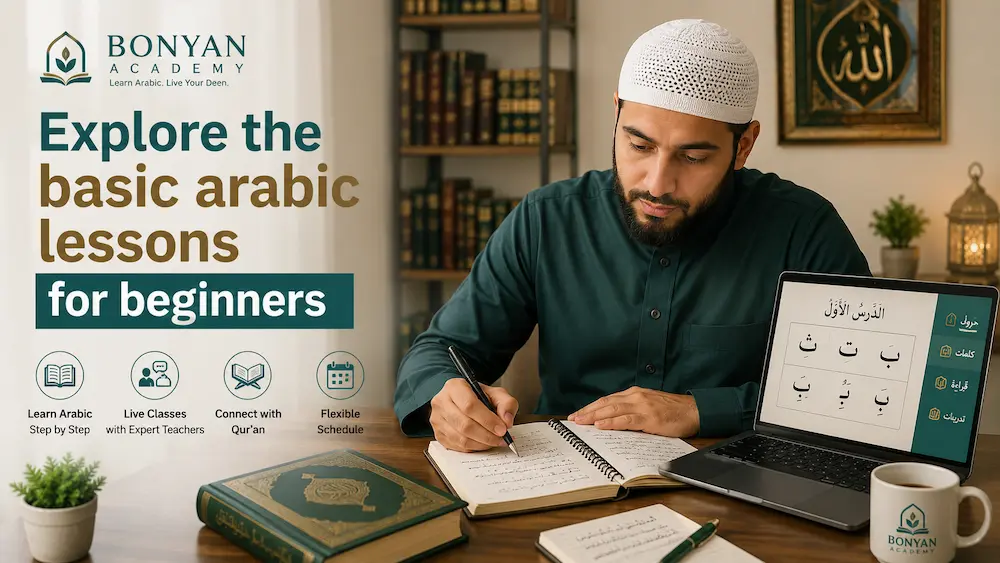
You do not need to keep guessing how Arabic letters join or whether you are pronouncing a Qur’anic word correctly. Basic Arabic lessons for beginners at Bonyan Academy give you direct support from a teacher who works with your level from the first class. You will read, repeat, speak, and receive correction while the lesson is still fresh in your mind. The course also helps you recognise words used in salah and build the confidence to continue towards Qur’anic understanding.
What are the best basic Arabic lessons for beginners?
- Effective basic Arabic lessons for beginners usually open with the script as it appears in complete words, because isolated letters do not prepare a learner for connected reading.
- The first stage should cover letter positions, short vowels, sukoon, shaddah, and tanween, followed by slow reading of familiar words.
- Pronunciation needs separate attention, especially with ع, ح, خ, ق, ص, and ض. These sounds affect meaning and matter in Qur’an recitation, salah, and du‘a.
- Vocabulary should be selected from everyday speech and Islamic practice: greetings, family terms, numbers, prayer words, common verbs, and simple questions.
- Well-planned Arabic language lessons for beginners add only the grammar required for immediate use, including pronouns, gender, agreement, and basic sentence order.
- Bonyan Academy brings reading, listening, speaking, and correction into one course, giving Muslim learners a practical route towards communication and deeper understanding of worship.
Read more about Learn Arabic in English Step by Step for Beginners.
How do I start learning Arabic as a beginner?
- A sound beginning comes from reading short, fully vowelled words rather than memorising twenty-eight letter names in isolation. This shows where letters join and where they remain separate.
- Basic Arabic lessons for beginners should place pronunciation beside reading. Sounds such as ح, ع, ق, and ض need repeated listening and direct correction before incorrect habits settle.
- Early vocabulary is most useful when drawn from real needs: greetings, family, time, numbers, simple verbs, and words already heard in salah, adhkar, and short surahs.
- Online Arabic classes for beginners add live reading practice. A teacher can notice weak vowel length, missed shaddah, or confusion between similar letters immediately.
- The best online Arabic course for beginners introduces only the grammar needed for the next task, then returns to practice. Bonyan Academy follows this gradual route, linking everyday Arabic with Qur’an reading and worship.
Should I learn the Arabic alphabet first?
- Yes, the alphabet should come first, but not as twenty-eight names learned by heart. Each letter needs to be seen inside a word, where its shape may change and its connection becomes clear.
- Early basic Arabic lessons for beginners should pair letters with fatḥah, kasrah, ḍammah, and sukūn. This allows reading to begin before every rule has been covered.
- Six letters—ا, د, ذ, ر, ز, and و—do not join to the letter after them. Knowing this early removes confusion in connected script.
- Similar groups such as ب ت ث and ج ح خ need slow comparison. The dots matter, while the mouth position separates sounds that may look alike.
- Strong beginner Arabic classes also use words from Al-Fātiḥah, salah, and du‘a. The alphabet then becomes part of meaningful reading, not a separate exercise, and supports later Qur’an study.
Is Arabic hard for English speakers to learn?
- Yes, Arabic may seem hard because the alphabet, writing direction, and some throat sounds are unfamiliar to English speakers.
- The script is less complicated than it first appears. Arabic has 28 letters, and most letters follow recognisable joining patterns once the learner reads them inside words.
- Pronunciation needs patient correction, especially with ح, خ, ع, and ق. Hearing a teacher and repeating aloud is more useful than reading English transliteration for weeks.
- Basic Arabic lessons for beginners should therefore build one skill at a time: sound, letter shape, short word, then a useful sentence.
- Muslim learners often recognise words such as salah, rahmah, sabr, and du‘a. This gives Arabic language lessons for beginners a meaningful link to worship and Qur’anic understanding.
- Arabic is demanding, but guided practice makes it manageable.
Explore the Words From Quran With Meaning .
How long does it take to learn basic Arabic?
- There is no fixed period for learning Arabic. Progress changes with age, lesson frequency, revision, and the learner’s main aim.
- In the first four to six weeks, many beginners can recognise the letters, follow their joined forms, and read short words carrying fatḥah, kasrah, and ḍammah.
- Writing often takes longer because letter shape changes at the beginning, middle, and end of a word.
- With two or three basic Arabic lessons for beginners each week, a learner may handle short sentences and simple introductions within three months.
- Qur’an learners may recognise familiar words from Al-Fātiḥah, adhkār, and salah earlier than other vocabulary, but meaning still requires guided study.
- After three to six months of beginner Arabic classes, most students can build a base for reading, basic conversation, and later Qur’anic Arabic.
What Arabic words should beginners learn first?
- Beginners should start with words they can use straight away, not long vocabulary lists with no clear purpose.
- Greetings such as as-salāmu ʿalaykum, wa ʿalaykum as-salām, marḥaban, and shukran help the learner take part in simple exchanges from the first lessons.
- Pronouns, question words, numbers, family names, days, and common verbs should follow. Words such as “I,” “you,” “where,” “want,” “go,” and “understand” make short sentences possible.
- Basic Arabic lessons for beginners should also include Islamic words heard regularly, including Allah, Qur’an, salah, duʿā’, masjid, sabr, and rahmah.
- Good Arabic language lessons for beginners teach each word with its sound, meaning, plural where needed, and one useful sentence.
- Learning ten connected words is more useful than memorising fifty unrelated ones.
Read more about the best Islamic Online Courses.
Should I learn MSA or dialect first?
- MSA is usually the safer first choice when the purpose is reading, writing, studying Islam, or understanding material shared across Arab countries.
- It appears in books, lessons, formal talks, and much religious teaching. Its grammar also gives a learner something stable to build on.
- Dialect has a different job. It is the language of homes, streets, shops, and ordinary conversation, and it changes from Egypt to the Gulf and the Levant.
- In basic arabic lessons for beginners, mixing several forms from day one often leaves students unsure which word belongs where.
- A practical route is to learn MSA first, then add one dialect linked to the learner’s family, travel plans, or community.
- Arabic speaking lessons for beginners can later show the difference without treating either form as wrong or inferior.
How do I practice Arabic every day?
- Set aside a fixed quarter-hour and keep the task narrow. One day may be reading, another listening, another writing.
- Read a short passage with vowel marks. Mark letters that join differently and repeat difficult sounds instead of rushing through the line.
- Keep five useful words from each lesson. Use them in brief sentences about home, study, family, or worship over the next few days.
- With basic Arabic lessons for beginners, review the teacher’s examples before adding new material. Early correction prevents weak pronunciation from becoming a habit.
- Islamic practice can include one phrase from salah, a short dhikr, or a familiar Qur’anic word. Check its meaning, not the sound alone.
- Online Arabic classes for beginners help with feedback, but daily recall, handwriting, and speaking aloud are what make Arabic stay.
What are the easiest Arabic lessons for beginners?
- The easiest lessons begin with letter sounds, not letter names alone. A beginner should hear ب, ت, and ث, watch the mouth position, then read them with fatḥah, kasrah, and ḍammah.
- Joining letters comes next. Short pairs and three-letter words make the changing shapes easier to notice without filling the page with rules.
- Basic Arabic lessons for beginners should then move to greetings, pronouns, question words, and verbs. These pieces allow useful sentences early.
- In arabic speaking lessons for beginners, repetition should include changes: “I read,” “he reads,” and “we read.” This teaches patterns through use.
- Religious learners can practise words already heard in salah, adhkar, and short surahs, while learning their meaning.
- Good online Arabic lessons for beginners keep each class narrow and correct pronunciation before mistakes settle properly.
Join our islamic online academy .
Can I learn Arabic without knowing grammar?
- Yes, Arabic can be started without formal grammar, especially when the first aim is recognising letters, learning phrases, or handling an exchange.
- Early speaking grows through patterns. A learner hears ana ureed, huwa yadhhab, and nahnu naqra’, then notices what changes before studying the rule.
- Basic Arabic lessons for beginners should still explain small points when useful, such as masculine and feminine words, pronouns, and why a verb ending changes.
- Students who learn Arabic lessons only through memorised sentences may speak at first, but often struggle when the sentence changes.
- In an Arabic for beginners course, grammar is best introduced in small amounts beside reading and conversation.
- For Qur’an and Islamic study, grammar becomes important because word endings and sentence structure can affect meaning.
How do I start speaking Arabic as a beginner?
- Start with a small set of sentences tied to real situations: saying your name, asking where something is, or telling a teacher that you do not understand.
- Each sentence should be heard first, then repeated, changed, and used again. “I read at home” can later become “I read the Qur’an at home.”
- In basic Arabic lessons for beginners, speaking works better when learners practise complete phrases instead of collecting separate words.
- Beginner Arabic classes should also correct letter sounds early, especially ع, ح, خ, and ق, because poor habits are harder to remove later.
- Islamic vocabulary gives useful material for practice: masjid, salah, wudu, du‘a, and simple greetings.
- The best way to learn Arabic online is to speak during the lesson, receive correction, and revisit the same phrases between classes.
What is the best app for basic Arabic lessons?
- The best app is the one that matches the learner’s purpose. A speaking app may help with travel, while a reading app is better for letters and Qur’anic vocabulary.
- For basic Arabic lessons for beginners, look for native-speaker audio, letter tracing, short-vowel practice, and reviews that bring old words back at the right time.
- Avoid apps that depend heavily on transliteration. Reading “salaam” for too long delays contact with Arabic script.
- A good app should let the learner hear a word, repeat it, then use it inside a short sentence.
- Muslim learners benefit from material linked to salah, adhkar, and common Qur’anic words, provided meanings are explained accurately.
- The best online Arabic course for beginners uses an app for revision and online Arabic lessons for beginners for correction and speaking.
join our Arabic Language Course.
How do I read Arabic letters correctly?
- Correct reading starts with the sound of each letter, not its English name. ب is read from the lips, while ح comes from the middle of the throat.
- Letter shape changes according to its place in the word. Beginners should practise the isolated, initial, middle, and final forms together.
- Short vowels matter. Fatḥah gives a short “a”, kasrah gives “i”, and ḍammah gives “u”. Sukūn means the letter carries no vowel.
- In basic Arabic lessons for beginners, similar letters such as ب, ت, ث and ج, ح, خ should be read side by side to avoid confusion.
- Long vowels must not be shortened, especially when reading Qur’anic words, because length can affect pronunciation and meaning.
- Reading aloud with a teacher allows mistakes in makhārij, joining, and vowel length to be corrected before they become familiar habits.
What is the best way to memorize Arabic vocabulary?
- Ten new words a week can be more useful than a page learned in one night. They should come from a lesson, such as the home, masjid, or study.
- Each word needs its Arabic spelling, sound, and an example. كتب is easier to remember beside “كتب الطالب الدرس” than as an English equivalent alone.
- Review should not follow a perfect timetable. Difficult words can return the next morning, after class, and when they appear in reading.
- Flashcards help, but recognition is not enough. The learner should cover the answer, pronounce the word, write it, and place it in a sentence.
- Words from salah, adhkar, and short surahs should be linked to their meaning and context, not memorised as sounds only.
- Vocabulary becomes usable when it reappears in speaking, reading, and writing.
Explore the Best Way to Memorize Quran Fast .
Why Bonyan Academy is the Best arabic Academy?
- Bonyan Academy keeps Arabic, Qur’an, and Islamic studies within the same learning path. Language is therefore connected to worship and understanding, not treated as a separate school subject.
- The starting level is chosen according to the student’s reading, pronunciation, age, and reason for studying. Children and adults do not receive one fixed plan.
- Live teaching makes a clear difference. Weak sounds, incorrect vowel length, and confusion between similar letters can be noticed during the lesson.
- Lessons move from letters and vowels into reading, vocabulary, and simple speech without loading a new learner with grammar too early.
- Flexible online study suits families managing school, work, and other responsibilities.
- A trial class allows the learner to see the teacher’s pace and method before enrolment.
Conclusion
Learning Arabic takes time, but the first stage becomes much easier when reading, listening, and speaking are practised together. Basic Arabic lessons for beginners should give learners enough space to understand letters, sound patterns, useful words, and short sentences without rushing into difficult grammar. For Muslims, Arabic also supports a clearer understanding of salah, adhkar, and familiar Qur’anic expressions. Bonyan Academy offers live online teaching for children and adults, with correction during the lesson and study plans based on the learner’s level and purpose.
FAQs
Is slow Arabic reading normal at the beginning?
Yes, the eye still needs time to follow connected letters and recognise the word as one shape. Slow reading is not a problem when the sounds are correct. Speed usually comes later, after common patterns stop looking new.
Why is the Arabic article “ال” not always pronounced the same way?
Its pronunciation changes with the letter that follows it. In al-qamar, the ل is heard. In ash-shams, it merges into ش. These are known as moon and sun letters, and they appear often in both ordinary and Islamic Arabic.
What is tanween in Arabic?
Tanween is the double vowel mark found at the end of some nouns: ـً, ـٍ, or ـٌ. It produces an “n” sound when the word is read continuously, though that sound may disappear when stopping.
Is a bilingual dictionary suitable for a beginner?
Yes, provided it includes example sentences and plural forms. A direct English meaning may not show how the Arabic word is actually used. Dictionaries become more useful when learners check the sentence, not only the translation.