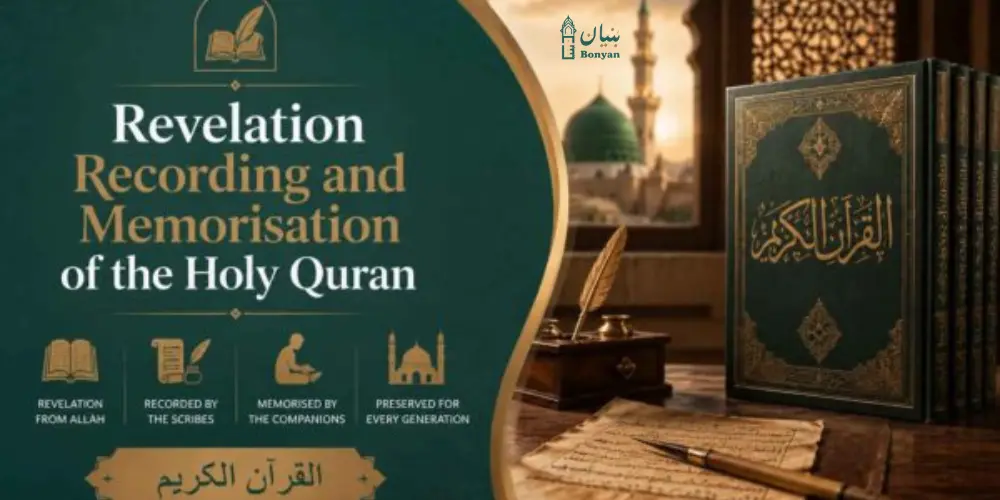
The subject of Revelation Recording and Memorisation of the Holy Quran helps Muslims understand how the Quran reached us with accuracy and care . It was not revealed all at once as a written book, but came from Allah to Prophet Muhammad in stages, guiding faith, worship, manners, and daily life. The Companions memorised, wrote, and taught it responsibly. At BonyanIslamic, students connect this sacred history with online Quran memorisation, Tajweed, revision, and clear step-by-step learning for children and adults.
How Was the Holy Quran recorded and revealed?
- The first revelation of the Holy Quran came to Prophet Muhammad ﷺ in Hira, with the opening verses of Surah Al-‘Alaq. It was not handed to him as a written manuscript; it reached him as divine speech, carried by Jibreel عليه السلام, then recited by the Prophet ﷺ with care and awe.
- Revelation continued for about twenty-three years. Makkan verses often built faith, Tawheed, patience, and certainty in the Hereafter, while many Madinan verses dealt with worship, family matters, social conduct, lawful dealings, and community life.
- Whenever verses were revealed, the Prophet ﷺ recited them to the Companions. Some memorised them straight away, and appointed scribes wrote them on the materials available at the time, while the Prophet ﷺ guided where the verses belonged.
- For anyone studying the holy quran in english, reading the holy quran, or joining the holy quran online classes, this history shows that Quran learning began with listening, correction, repetition, and careful transmission.
learn more about islamic studies Course
Why Was the Holy Quran Revealed in Stages?
- Revelation Recording and Memorisation of the Holy Quran didn’t happen in one moment because the Quran was meant to guide people through real life, and that kind of guidance works better when it comes step by step rather than all at once.
- The early Muslim community was going through constant changes, events, and questions, so the verses would come at the exact time they were needed, almost like immediate answers to lived situations rather than general information.
- There was also a human side to it; learning small portions over time made it easier for the Companions to remember, reflect, and apply what they heard instead of trying to take in large amounts in a short time, which strengthened their connection with the holy quran.
- Many of the reasons and occasions of revelation of the holy quran are directly tied to these events, which is why understanding context becomes important when studying how verses were revealed and applied in real life.
- Even today, this approach still reflects in how people learn through the holy quran online, where steady learning and repetition are more effective than rushing through memorisation.
Who Were the Scribes of the Holy Quran?
- The scribes of the Holy Quran were Companions whom the Prophet Muhammad ﷺ trusted to write the revealed verses as he received them. They are known in Islamic tradition as the writers of revelation, because their duty was connected directly to the words revealed from Allah, not to personal explanation or independent arrangement.
- Among the well-known scribes were Zayd ibn Thabit, Ubayy ibn Ka‘b, Ali ibn Abi Talib, Mu‘awiyah ibn Abi Sufyan, and others. Zayd ibn Thabit became especially known because of his later role in the careful collection of the Quran after the Prophet’s death.
- The Prophet ﷺ would recite the revealed verses to them and guide where each verse belonged in its surah. This shows that writing served revelation, while memorisation protected recitation through living transmission.
- The reasons and occasions of revelation of the Holy Quran helped the Companions understand when and why certain verses were revealed. As for the last revelation of Holy Quran, scholars mentioned different reports, which shows their careful attention to timing and preservation.
read more about Words from quran with meaning
The Difference Between Quran Compilation and Quran Revelation:
| Point of Comparison | Quran Revelation | Quran Compilation |
|---|---|---|
| Meaning | Revelation means the words of Allah being sent down to Prophet Muhammad ﷺ through Jibreel عليه السلام. | Compilation means gathering the already revealed Quran into a preserved written form. |
| Time | It took place during the Prophet’s lifetime over about twenty-three years, from the first revelation in Makkah until the final period in Madinah. | It happened after revelation had ended, especially during the caliphates of Abu Bakr رضي الله عنه and later Uthman رضي الله عنه. |
| Source | Its source was divine. No Companion added, removed, or changed any verse. | Its work was preservation, not authorship. The Companions collected what had already been revealed, memorised, and written. |
| Method | The Prophet ﷺ received verses, recited them, taught their meanings, and directed where they belonged in each surah. | Zayd ibn Thabit رضي الله عنه and others checked written records with memorised recitation before accepting material. |
| Importance | Revelation gave Muslims the message of guidance. | Compilation protected the Ummah from dispute and preserved one agreed written Mushaf for later generations. |
Is the Holy Quran We Read Today the Same as What Was Revealed?
- Muslims believe that the Holy Quran we read today is the same revelation sent down to Prophet Muhammad ﷺ, because its preservation was not left to memory alone or writing alone. It was protected through recitation, memorisation, written records, and continuous teaching from one generation to another.
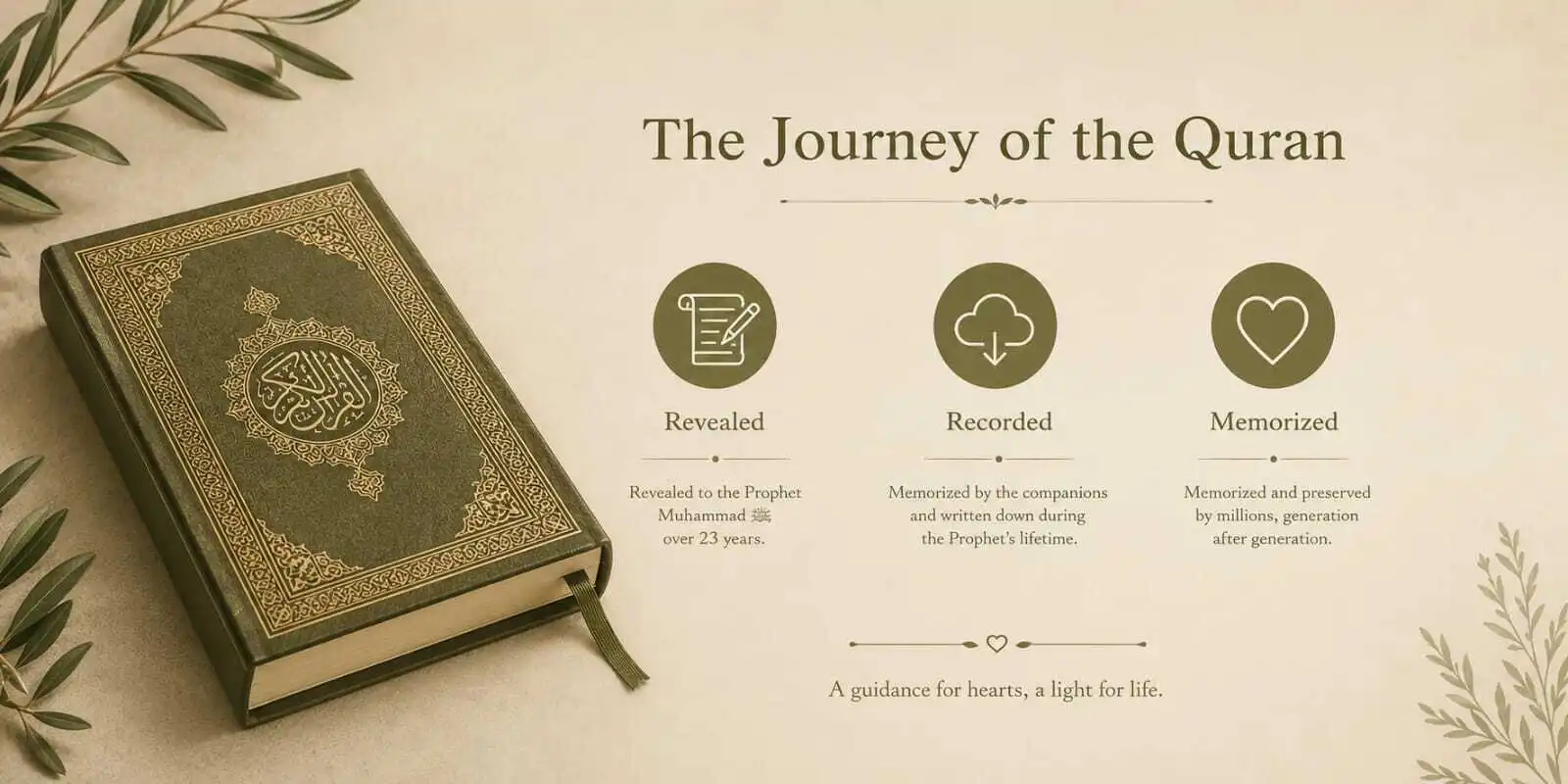
- During the Prophet’s lifetime, the Companions heard the Quran directly from him. Many memorised it, while the scribes wrote the revealed verses under his instruction. This means that Revelation Recording and Memorisation of the Holy Quran worked together from the earliest period, not as two separate stages.
- After the Prophet ﷺ passed away, Abu Bakr رضي الله عنه ordered the collection of the Quran into one written record, especially after the death of many reciters. Later, Uthman رضي الله عنه sent standard written copies to protect the Ummah from disagreement in recitation.
- The Quran was preserved through mutawatir transmission, meaning large numbers of Muslims received and taught it in every generation. This is why Muslims recite the same divine book today with confidence and reverence.
Learn more about Quran Memorization Course
Common Misconceptions about Quran Preservation:
- A common misconception is that the Quran was preserved only after the Prophet ﷺ passed away. This is not accurate. During his lifetime, verses were recited aloud, memorised by Companions, written by appointed scribes, and reviewed through worship, teaching, and daily recitation.
- Another mistake is confusing compilation with revelation. Compilation did not mean producing a new text. It meant gathering what was already revealed, known, memorised, and written, especially after the Battle of Yamamah, when many reciters were martyred.
- The Complete History of Quranic Revelation also shows that memorisation was not casual repetition. The Methods Used by Early Muslims to Memorise the Quran included listening directly from the Prophet ﷺ, repeating in prayer, teaching others, and connecting verses with practice.
- In this sense, the Revelation Recording and Memorisation of the Holy Quran was preserved through a strong chain: revelation, Prophetic recitation, memorisation, written witnesses, communal review, and later standard Mushafs sent by Uthman رضي الله عنه to protect public recitation from dispute.
- This understanding helps students respect the Quran as a living recitation, not only a historical manuscript.
What Every Muslim Should Know About the Revelation and Preservation of the Quran:
- Every Muslim should know that the Holy Quran was not preserved by chance. Its preservation began with revelation itself: Jibreel عليه السلام brought the words to the Prophet ﷺ, the Prophet recited them, the Companions memorised them, and selected scribes wrote them down.
- The Revelation Recording and Memorisation of the Holy Quran shows that Muslims received the Quran through both sound and script. Recitation protected pronunciation, while writing helped preserve the verses as a recorded text.
- When Muslims read the holy quran today, they are connected to a chain of recitation that goes back to the Prophet ﷺ. This is why learning should not depend on translation alone, even when studying the holy quran in english.
- A Muslim should also understand that the holy quran online can be learned properly when there is a qualified teacher, Tajweed correction, regular revision, and respect for the order of recitation that is will be found in our bonyan islamic academy
- To read the holy quran correctly is not only to finish pages, but to receive guidance with accuracy, humility, and practice.
learn more about Quran Tajweed With English Translation
How to Learn Quran Memorisation Using the Prophet’s Own Methods?
- The Prophet ﷺ received the Quran by listening before teaching it to others. This gives the first rule of memorisation: the student should hear correct recitation from a qualified teacher, not depend only on personal reading or silent repetition.
- Jibreel عليه السلام reviewed the Quran with the Prophet ﷺ in Ramadan, and in the final year this review happened twice. This shows that revision is not a secondary step; it is part of preserving what has already been memorised.
- The Revelation Recording and Memorisation of the Holy Quran also teaches gradual learning. A student should memorise small portions, repeat them accurately, understand their meanings, and connect them with prayer and daily worship.
- Knowing the reasons and occasions of revelation of the Holy Quran helps memorisation become deeper, because the verse is linked to meaning, context, and guidance, not sound alone.
- Even discussions about the last revelation of Holy Quran remind students that Quran learning needs care, humility, and respect for scholarly detail.
The Importance of Tajweed in Quran Memorisation:
- Tajweed matters because the Quran was not received as silent text only. It was heard, recited, corrected, and passed on by voice. A student may remember a verse, but if the letters are not pronounced correctly, the memorisation still needs repair.
- In the Revelation Recording and Memorisation of the Holy Quran, accuracy began with the Prophet ﷺ himself. The Companions learned from his recitation, not from guessing how words should sound. This is why a teacher’s ear is still important in Hifz.
- The Complete History of Quranic Revelation shows that recitation came before written copies. The Mushaf protects the text, but Tajweed protects the spoken delivery: where the tongue rests, how long a madd is held, when ghunnah appears, and where stopping changes the flow of meaning.
- The Methods Used by Early Muslims to Memorise the Quran were slow, repeated, and supervised. They listened, repeated, prayed with what they learned, and reviewed often. Tajweed keeps that same discipline alive for students today.
you can ask yourself Can you read quran without tajweed ?
How Children Can Start Quran Memorisation Effectively?
- Children should begin Quran memorisation through gentle talaqqi: listening to a correct recitation, repeating after a teacher or parent, then reciting back for correction. This is closer to the spirit of Revelation Recording and Memorisation of the Holy Quran, where the Quran was preserved by hearing, recitation, correction, and careful transmission.
- A child should not be pushed to memorise large portions too early. It is better to start with Al-Fatihah and short surahs from Juz ‘Amma, with clear pronunciation, simple meanings, and regular revision. Strong memorisation is built slowly, not by finishing pages quickly.
- The Complete History of Quranic Revelation teaches an important educational lesson: gradual learning has wisdom. The Quran was revealed over time, and children also need time, repetition, patience, and emotional safety while learning Allah’s words.
- The Methods Used by Early Muslims to Memorise the Quran can inspire children’s learning without forcing adult methods on them: repeated listening, reciting in prayer, reviewing old portions before new ones, using one familiar Mushaf when they can read, and keeping lessons short enough to preserve love for the Quran.
Read more about Online Hifdh Program for Kids Adults and Sisters
Benefits and Teaching Methods of Online Quran Memorisation Inspired by Early Islamic Tradition:
- Online Quran memorisation should not be presented as a replacement for the traditional way of receiving the Quran. Its value appears when it preserves the core method of talaqqi: the student listens to a qualified teacher, recites back, receives correction, and repeats until the verse is stable.
- In early Islamic learning, memorisation was connected to sama‘, ‘ard, tasmi‘, and muraja‘ah: hearing the Quran, presenting one’s recitation to a teacher, being tested in what was memorised, and returning constantly to previous portions.
- The Revelation Recording and Memorisation of the Holy Quran shows that preservation depended on accuracy, supervision, and continuous transmission. For this reason, a serious online program must include live correction, Tajweed notes, fixed revision schedules, and careful pacing.
- A useful online Hifz plan should separate the daily lesson from recent revision and older revision. This protects the student from the common mistake of memorising new verses while earlier portions become weak.
- For families, the main benefit is access to reliable Quran teachers even when local options are limited, while still keeping discipline, respect, and personal follow-up.
Conclusion
The Revelation Recording and Memorisation of the Holy Quran reminds every Muslim that the Quran reached us through divine revelation, careful recitation, trusted writing, and continuous memorisation. This sacred history is not only for study; it should shape the way we learn today. A serious student needs correct Tajweed, patient revision, qualified guidance, and love for Allah’s words. If you want to begin or support your children’s Quran journey Visit bonyan Academy can help you learn online with structure, care, and respect for the tradition of talaqqi and start with the Holy Quran today in your home with confidence. Contact us and get the free trial
FAQs
How Did the Prophet’s Companions Memorise the Holy Quran?
The Companions did not memorise the Holy Quran as a private reading exercise. They heard it from the Prophet Muhammad ﷺ, repeated it in his presence or before trusted reciters, and used what they learned in prayer. Many of them learned gradually, holding to the verses until they understood and practised them.
What does Revelation Recording and Memorisation of the Holy Quran mean?
It means studying how the Quran reached the Muslims from the first moment of revelation until it became known, recited, written, and memorised among the Companions. The Prophet Muhammad ﷺ did not receive the Quran as a ready manuscript.
Was the Quran written down during the Prophet’s lifetime?
Yes, but not as one complete bound Mushaf. The revealed verses were written during the Prophet’s lifetime by scribes of revelation. They wrote on the materials available to them, while the Quran was also being memorised and recited by many Companions.
Can online Quran memorisation follow the traditional method?
It can, when the lesson is built around live listening and correction, not just recorded videos. A serious student should recite to a teacher, receive Tajweed correction, repeat weak parts, revise old portions, and move slowly enough to keep the memorisation firm.