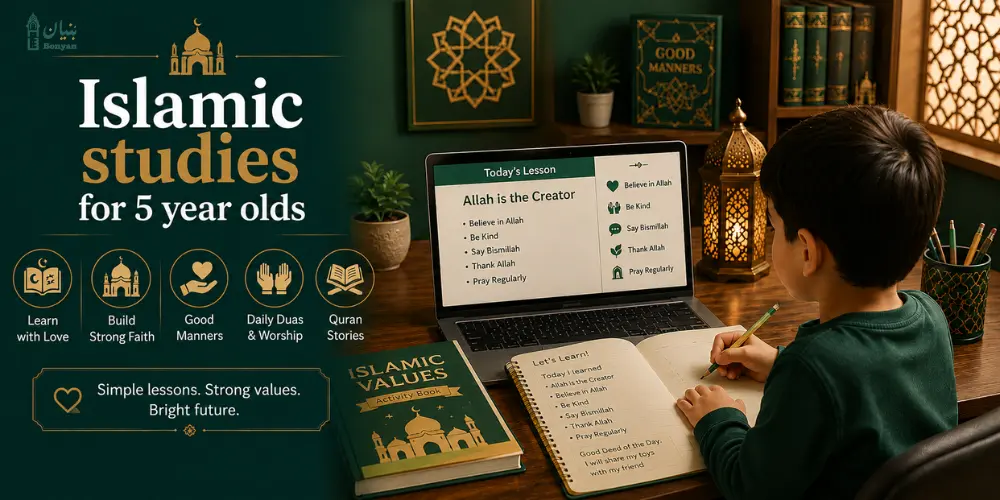
A five-year-old may ask why Muslims pray, who made the world, or why we say Bismillah before eating. These small questions are often the best starting point for learning about Islam. Islamic studies for 5 year olds should answer them with simple words, familiar examples, short stories, and activities that suit a young child’s attention span. Parents looking for organised Islamic studies online can use Bonyan Academy to introduce basic beliefs, duas, manners, and worship in a way that fits naturally into family life.
What is Islamic studies for 5 year olds?
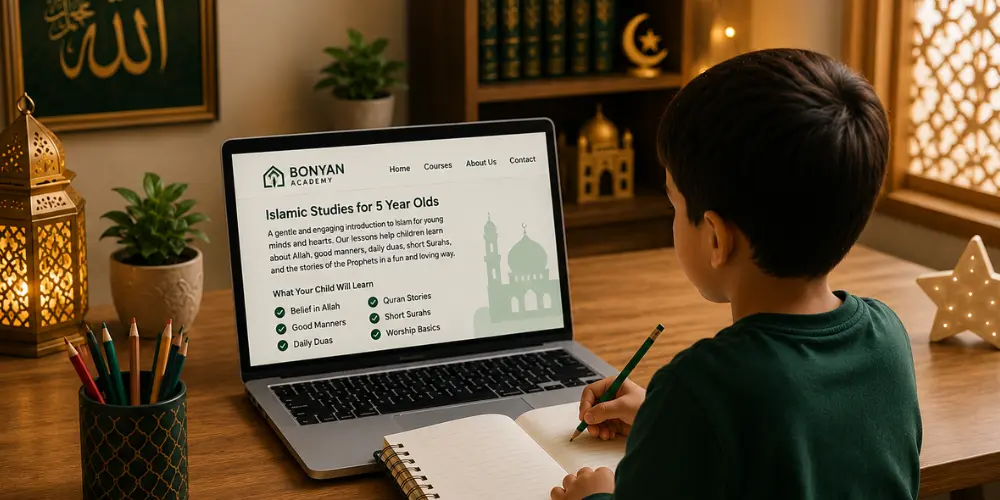
At five, a child may already know that Allah made the world, yet still ask where Allah is or why Muslims pray. Islamic studies for 5 year olds gives simple, honest answers while introducing belief in Allah, the Prophet Muhammad ﷺ, the Qur’an, good manners, and everyday acts of worship.
The aim is not to fill a child’s memory with difficult terms. It is to help faith make sense through familiar moments: saying Bismillah before food, thanking Allah for blessings, using salam, learning short surahs, hearing prophetic stories, and practising the basic movements of wudu and salah gently at home.
join our islamic studies Course
How do I teach Islamic studies for 5 year olds?
- Begin with the questions your child already asks. When they wonder who made the sky, animals, or their family, explain that Allah is the Creator and that His care can be seen in the blessings around them.
- Keep Islamic studies for 5 year olds short and regular. Ten focused minutes spent learning one dua, discussing a prophetic story, or practising a salah movement is usually more useful than a long lesson that leaves the child tired.
- Introduce the main religious beliefs in Islam through clear examples. Teach that Allah is One, Muhammad ﷺ is His Messenger, the Qur’an is Allah’s word, and Muslims believe in angels, earlier prophets, the Last Day, and qadar .
- Connect knowledge to behaviour. A lesson about Allah’s generosity can lead to sharing food, while learning that Allah hears us can encourage the child to make dua in their own simple words.
- Let Islamic studies include listening, speaking, movement, and repetition. Use picture cards without depicting prophets, short Qur’an recitation, role-play for manners, and gentle correction rather than tests or pressure.
What are the core Islamic beliefs for this age?
- A young child often understands faith through what they can see around them. Rain, animals, family, food, and the changing sky can all help explain that Allah created the world and continues to care for His creation.
- Tawhid should remain simple and clear: Allah is One, has no parents or children, and no one shares His power. Complicated theological terms are unnecessary in Islamic studies for 5 year olds.
- Belief in angels can begin with their obedience to Allah and their unseen nature. Children do not need imaginative descriptions that are unsupported by the Qur’an or authentic Sunnah.
- Prophets should be introduced as truthful people chosen by Allah to guide humanity. The child can also learn that Muhammad ﷺ was the final Messenger and that Muslims respect every prophet.
- The Qur’an, the Last Day, and qadar can be explained gradually. Good Islamic studies online and carefully planned online Islamic courses should present these beliefs with reassurance, accuracy, and language a child can genuinely understand.
read more about Enrich Your Faith with the Best Islamic Online Courses
What are the Daily Islamic Habits Children Should Learn?
- Mealtimes offer a natural starting point. A five-year-old can say Bismillah before eating, use the right hand, take what is nearest, avoid criticising food, and finish with Alhamdulillah. These habits are learned more easily by watching adults than through repeated correction.
- Bathroom routines also carry Islamic manners. Children can learn the dua before entering, privacy, cleaning with the left hand, washing properly, and leaving the space tidy. At this age, one step at a time is enough.
- In Islamic studies for 5 year olds, salam, honesty, keeping promises, and returning borrowed items deserve daily practice. They teach that good character is part of worship, not a separate subject.
- Bedtime may include the sleeping dua, lying on the right side, and reciting the short protective surahs with a parent.
- Useful online Islamic courses give families one habit to practise during the week. An Islamic studies Course should help parents notice progress at home rather than relying on worksheets alone.
What is the best Islamic curriculum for young children?
- A strong curriculum does not rush a child through too much material. It moves in small steps, returning to key ideas until the child can recognise them, explain them simply, and connect them with daily life.
- The plan should cover aqeedah, short Qur’an passages with meaning, selected seerah stories, basic fiqh, and adab. Each part needs a clear purpose rather than a place on a crowded syllabus.
- For Islamic studies for 5 year olds, one clear aim per lesson is usually enough. A short story, practical task, and brief review can hold attention without creating pressure.
- The material must come from reliable Islamic sources. Weak stories, frightening descriptions, and questions beyond the child’s stage should be left out. Teachers should also separate Islamic teachings from customs.
- Good online Islamic courses show parents what was taught and what can be practised afterwards. An Islamic studies Course is more useful when progress appears in understanding, recitation, manners, and participation, not worksheets alone.
Islamic Studies for 5 Year Olds: Home Teaching vs Online Islamic Education:
| Point | Home Islamic Teaching | Online Islamic Education |
|---|---|---|
| How learning fits into the day | Home teaching happens inside the child’s ordinary routine. A parent can explain gratitude while sharing food, practise a dua before sleep, or correct a manner when the real situation occurs. | Online lessons give the child a separate learning time with a teacher who can organise the topic and guide the lesson from beginning to end. |
| Main strength | It keeps Islamic learning close to family life, so the child sees faith in meals, play, salah, bedtime, and everyday behaviour. | A teacher can hear Qur’an recitation, notice pronunciation mistakes, and explain points that parents may not feel confident teaching alone. |
| Pace and attention | The pace can change easily. A lesson may stop after five minutes or continue because the child is interested. | The class has a set time, although a good teacher should still notice when the child is tired, distracted, or losing focus. |
| What the adult brings | Parents know the child’s temperament, habits, fears, and the moments when a lesson will feel natural. | The teacher brings subject knowledge, lesson structure, and experience in explaining Islamic ideas to young learners. |
| Possible limitation | A parent may miss Qur’an pronunciation errors or find it difficult to organise topics in a steady order. | An online lesson cannot fully replace the small daily moments when Islamic manners are practised at home. |
| Best approach | Family practice helps the lesson become part of real life instead of something the child only hears once a week. | Online Islamic education can introduce the lesson, while parents carry it into meals, salah, play, and bedtime. |
How do I make Islamic learning fun for kids?
- A lesson may begin with a bag containing a prayer mat, miswak, small water cup, and clean scarf. Taking out each item slowly gives the child time to name it, touch it, and understand where it belongs in Muslim life.
- Stories need pauses rather than a long explanation at the end. After a short account from the seerah, children can arrange three picture cards in order and mention one action they remember.
- In Islamic studies for 5 year olds, games should serve a clear purpose. Matching a dua to its occasion, sorting kind and unkind actions, or finding Arabic letters around the room makes revision less tiring.
- Art activities can record learning without inventing religious images. A child might decorate a sadaqah box, mark prayer times on a paper clock, or make a booklet of Allah’s blessings.
- During online Islamic classes, teachers can shift between recitation, movement, objects, and short tasks. Children remain involved, while the lesson keeps its Islamic meaning and does not become entertainment alone.
Should Islamic studies for kids be in English or Arabic?
- The language used for explanation should be the one a child understands most easily. If English is spoken at home, it can carry lessons about Allah, prophets, manners, and worship without leaving important ideas unclear.
- Arabic still has a special place. Children need to hear Qur’anic words correctly, recognise common phrases such as Bismillah and Alhamdulillah, and learn short surahs from a teacher who can correct pronunciation gently.
- In Islamic studies for 5 year olds, English and Arabic do not need to compete. A teacher may explain the meaning in English, introduce the Arabic term, then return to it several times until the child knows both.
- Transliteration can help briefly, but relying on it for too long may fix inaccurate sounds. Listening and repeating are safer for Qur’an, duas, and words used in salah.
- Good online Islamic education adjusts the balance to the learner. Well-planned Islamic classes protect the Arabic wording of worship while making its meaning clear in the child’s everyday language.
join our Arabic Language Course
What duas should a 5 year old learn first?
- The first duas should be the ones a child can use every day. Begin with Bismillah before eating, Alhamdulillah afterwards, and the words said when waking, sleeping, entering the bathroom, and leaving it.
- Meaning should come before perfect recall. When a child learns Rabbighfir li, explain that it means “My Lord, forgive me.” This helps the words feel like a request to Allah, not a sound repeated for praise.
- In Islamic studies for 5 year olds, two or three lines at a time are enough. Say the dua slowly, divide it into parts, then return to it during the moment when it belongs.
- Pronunciation matters, but correction should remain gentle. A parent can model the Arabic and repeat the difficult sound without interrupting the child after every word.
- In reliable Muslim classes online, the teacher should explain when each dua is said and help parents practise it during the week. A child may learn only one short dua, but hearing it at the right moment each day is what helps it stay.
How do I teach my child about Allah?
- A five-year-old notices Allah through things close to home: rain, food on the table, a baby, or an animal growing. These moments can be named as blessings without suggesting that Allah is part of His creation.
- Keep tawhid plain. Allah is One, has no partner, and nothing resembles Him. A child should not be asked to picture Allah or draw Him, because imagination cannot describe the Creator.
- One name of Allah at a time is enough. Ar-Razzaq can be linked to provision, Al-‘Alim to what Allah knows, and Al-Ghafur to forgiveness after a mistake.
- During Islamic studies for 5 year olds, a child may speak to Allah about fear, gratitude, or something they hope for. This gives dua and tawbah meaning through life.
- Some questions need only a few words. Parents can answer from the Qur’an and authentic Sunnah, then stop before adding guesses. The religious beliefs in Islam should reach a young child without frightening language or invented details.
How do I start teaching salah to a 5 year old?
- Let the child first stand beside a praying parent. Watching the same movements each day gives salah a familiar place in family life before every word and condition is explained.
- Begin with one part at a time: facing the qiblah, saying Allahu Akbar, placing the hands, bowing, and making sujood. The order matters more at this stage than perfect posture.
- In Islamic studies for 5 year olds, salah should be introduced gently. A child of five is still below the age when regular prayer training is formally required, so missed attempts should not bring blame or shame.
- Teach Al-Fatihah slowly, alongside the short phrases used in ruku and sujood. Children may practise outside prayer until the words become easier to recall.
- Good Islamic studies also explains why Muslims pray: to worship Allah, remember Him, and thank Him. A small prayer mat, calm encouragement, and joining one family prayer can help the child return willingly the next day.
Is Islamic studies important at a young age?
- Yes, at five, children notice why parents stop to pray, say Alhamdulillah after good news, or listen to the Qur’an. A simple explanation helps them join worship with understanding instead of copying movements they do not recognise.
- Islamic studies for 5 year olds gives names to what they see. They learn that Ramadan is a month of fasting, the mosque is a place of worship, and Eid begins with gratitude to Allah, not only clothes or sweets.
- Lessons at this age should leave room for questions. A child may wonder where a loved one goes after death, why friends celebrate different holidays, or why Muslims avoid certain actions. Calm answers can stop fear and confusion from growing.
- Nothing should feel like an exam. Five-year-olds are still learning through repetition, example, and affection.
- Well-taught Islamic classes can support parents, especially when the teacher explains one idea and leaves space for it to be revisited at home.
What is age appropriate Islamic education?
- At five, useful teaching starts with things a child can actually notice: a prayer call, a family fast, a kind act, or a mistake followed by an apology. These moments give religious words a real setting.
- Islamic studies for 5 year olds should not turn every topic into memorisation. A child may learn what sadaqah means by choosing a toy to give, or understand gratitude by naming one blessing before bed.
- Some subjects need careful limits. Jannah can be described with hope, death with simple honesty, and sin with the reminder that Allah accepts sincere repentance. Graphic punishment and frightening detail do not belong here.
- Progress may look uneven. One week a child remembers a whole dua; the next, only when it is used. That is normal at this age.
- In online Islamic classes, the teacher should notice tiredness, confusion, and curiosity. Changing the example or pausing for a question is often more useful than pushing through the planned lesson.
read more about Complete Guide to Islamic Special Religious Education
How much should a 5 year old learn about Islam?
- There is no fixed number of surahs, duas, or topics a five-year-old must complete. The amount depends on attention, language, previous learning, and whether the child can use what has been taught outside the lesson.
- A reasonable foundation includes knowing that Allah is One, Muhammad ﷺ is His Messenger, the Qur’an is Allah’s word, and Muslims worship Allah alone. These ideas matter more than collecting many disconnected facts.
- One or two short surahs may be learned carefully, together with their simple meaning. The child can also practise a few daily duas and recognise the main movements of salah without being expected to perform everything independently.
- Islamic studies at this age should leave space for forgetting and returning. A child who needs several weeks for one dua is not falling behind.
- Parents can slow down when Arabic words become mixed, lessons cause frustration, or earlier material disappears quickly. Steady understanding, affection for worship, and small changes in conduct are more useful signs of growth than the number of pages completed.
What activities help children learn Islam?
- A nature walk can become a lesson without feeling formal. Children can look at leaves, clouds, insects, or birds, name what Allah created, and choose one blessing to thank Him for.
- Wudu is easier to remember when the child handles each step. Place picture cards in the wrong order, let the child correct them, then practise at the sink.
- A family calendar can mark Jumu‘ah, Ramadan, Eid, and the Islamic months. A symbol for each occasion helps children notice that Muslim worship follows a yearly rhythm.
- Role-play works well for manners. One child can welcome a guest, return something borrowed, respond to a sneeze, or apologise after causing harm. Pause the scene and let the child choose the kinder response.
- Useful Islamic learning activities should finish with one takeaway. After Qur’an listening, a mosque visit, or a charity task, ask the child to draw or say what they remember and one action they can try.
Read more about Online Hifdh Program for Kids Adults and Sisters
Can online Islamic studies work for kindergarten age children?
- Yes, they can, but a five-year-old needs more than a teacher talking on screen. The child should be asked to point, repeat, move, choose, or show an object every few minutes.
- A familiar teacher makes a noticeable difference. When the same person remembers the child’s name, previous dua, or favourite story, the lesson begins to feel like a real class rather than another video.
- Parents do not have to sit through every minute. Staying within reach is usually enough, especially if the child needs help finding a page, unmuting the microphone, or settling after losing focus.
- Qur’an and Arabic need live listening. A teacher can hear a missed sound in Al-Fatihah or a short surah and correct it gently before the child becomes used to saying it incorrectly.
- Online Islamic classes are working when something remains after the call ends. The child may use the new dua at dinner, copy a salah movement later, or retell part of a prophetic story during play.
read more about Revelation Recording and Memorisation of the Holy Quran
Why Bonyan Academy is the best choice for Islamic Courses?
- Parents choosing Bonyan Academy need more than a child-friendly screen. Lessons should place Qur’an, belief, worship, and manners in a clear order, so each new idea has something familiar to build on.
- Having continuity with one teacher matters at this age. A teacher who remembers a child’s pronunciation, confidence, and recurring mistakes can adjust the pace instead of starting over every session.
- Parents should know what happened during class. A short note on the surah, dua, or behaviour covered makes home practice specific and prevents confusion.
- In a well-run Islamic learning program, correction stays gentle but accurate. Arabic sounds, salah words, and religious facts should not be ignored, yet a five-year-old should never feel embarrassed when they forget.
- Bonyan Academy can serve families by combining structured teaching with learning from home. The clearest sign of value is not a long syllabus, but a child who returns willingly and begins using what was learned in worship and daily conduct.
Conclusion
At five, progress may be as small as remembering when to say Bismillah, asking a question about Allah, or standing beside a parent during salah. Those moments matter. They show that the lesson is beginning to appear in the child’s real life. When choosing Islamic studies for 5 year olds, look for teaching that your child can understand and return to without pressure. Visit Bonyan Academy, explore the available course, and choose a starting point that suits your child’s pace and fits naturally into your family’s week.
FAQs
Should a 5-year-old learn the Arabic alphabet before starting Qur’an?
No, a child can listen to short surahs and repeat them before they recognise every Arabic letter. Letter learning and recitation may develop side by side. What matters is hearing the words correctly and avoiding dependence on English transliteration, which cannot represent every Arabic sound accurately.
Is it enough for a young child to memorise surahs?
No, memorisation has value, but children should also hear a simple explanation of what they recite. Knowing that Surah Al-Falaq asks Allah for protection, for example, gives the words a place in the child’s life instead of leaving them as sounds remembered only for class.
Should I reward my child for learning Islam?
Small rewards can encourage effort, especially when a child completes a difficult task. They should not become payment for every prayer, dua, or good deed. Praise, choosing the bedtime story, or spending time together often works better than sweets and expensive gifts.
What should I do when my child asks a question I cannot answer?
It is fine to say that you need to check. Giving a made-up answer can leave a child with a mistaken belief that is harder to correct later. Write the question down, ask a trustworthy teacher, and return to it when you have a clear answer.